Montgomery Street-Columbus Circle Historic District (Boundary Increase and Decrease)

The National Park Service has not published a boundary polygon for this district; the map shows the listed properties inside it and the district's reference point.
Why it's listed
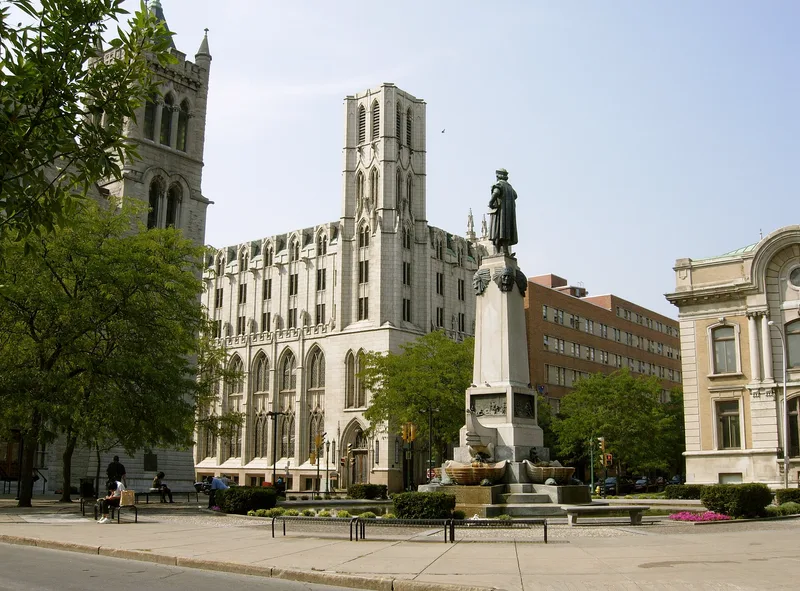
Montgomery Street and Columbus Circle form a compact cluster of institutional buildings in the heart of downtown Syracuse, covering about nine acres. The district starts at the circle, where the Fourth Onondaga County Courthouse, the Cathedral of the Immaculate Conception and First Gospel Church face one another, and continues north along Montgomery Street to the Hills Building. Notable buildings include St. Paul's Cathedral of 1885, the Beaux Arts Syracuse Public Library of 1901-02, the Onondaga Historical Association building and the Masonic Temple. The courthouse was designed by Archimedes Russell and Melvin King. Syracuse grew from a small settlement into an industrial center because of the Erie Canal, varied industry and a railroad opened in 1839. The district reflects that growth through buildings of similar scale, materials and craftsmanship. A few modern intrusions exist, but the area keeps its visual integrity and is described as the only architecturally coherent group of its kind remaining in the city.
Machine-generated summary. This summary was generated by a language model from the official nomination document and has not been reviewed line by line by an editor. It may contain errors. Check the source document before relying on any detail. Source: nomination document (PDF) · catalog entry. Generated October 2026 (model claude-sonnet-5-5, prompt v1.0-2026-10-29).
| Period of significance | 1800-1899 |
|---|---|
| Styles | Beaux Arts, Gothic Revival, Greek Revival, Romanesque, Renaissance Revival and Classical Revival |
| Areas of significance | Architecture, Commerce, Community Planning and Development |
| Acreage | 17.34 |
| Boundary source | not published |
| Full listing page | Montgomery Street-Columbus Circle Historic District (Boundary Increase and Decrease) (property record) |
What listing means for this property
This is a historic district. Buildings within its boundary are either contributing (they add to the district's significance) or non-contributing. Owners of contributing income-producing buildings can claim the 20% federal rehabilitation tax credit; homeowners should look at state credits. National Register districts impose no design review by themselves; a local historic district ordinance, if one exists, does (the difference explained).
General information, not legal or tax advice. Rules change; confirm with your State Historic Preservation Office or a qualified adviser.