Market Street Historic District

Why it's listed
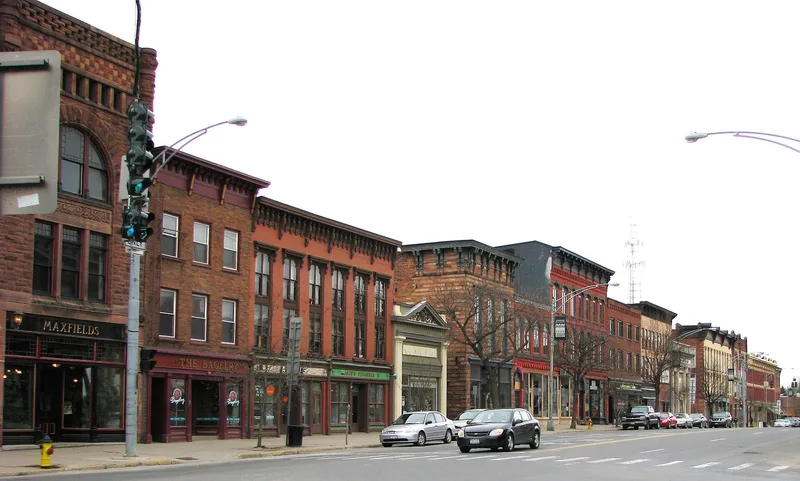
Market Street in Potsdam, New York, preserves the village's entire surviving nineteenth-century commercial core: twenty-seven buildings along two blocks of Market Street and one block of Raymond Street, built between 1820 and 1900. Two to four stories high, they are mostly sandstone or brick in reddish tones, giving the streetscape a uniform scale and color. Federal, Italianate, Romanesque Revival and Classical Revival styles are all represented. Early shops used Potsdam sandstone laid in the slab-and-bind manner, and later blocks such as the Cox Block of 1888 show elaborate Romanesque detailing. Many were built by local merchant-developers, including Martin Van Buren Ives. Fires in 1890 and 1896 destroyed older buildings and prompted new construction, and fires in the 1940s removed some upper floors and cornices. Potsdam grew from 1806 on its river water power, railroad connections and later its teachers college. The district was listed because it records that commercial and architectural history so coherently, despite one modern one-story intrusion.
Machine-generated summary. This summary was generated by a language model from the official nomination document and has not been reviewed line by line by an editor. It may contain errors. Check the source document before relying on any detail. Source: nomination document (PDF) · catalog entry. Generated October 2026 (model claude-sonnet-5-5, prompt v1.0-2026-10-29).
| Period of significance | 1820-1900 |
|---|---|
| Styles | Federal, Italianate, Romanesque Revival, and Classical Revival |
| Areas of significance | Commerce, Architecture |
| Acreage | 8 |
| Boundary source | NPS cultural-resource GIS polygon |
| Full listing page | Market Street Historic District (property record) |
What listing means for this property
This is a historic district. Buildings within its boundary are either contributing (they add to the district's significance) or non-contributing. Owners of contributing income-producing buildings can claim the 20% federal rehabilitation tax credit; homeowners should look at state credits. National Register districts impose no design review by themselves; a local historic district ordinance, if one exists, does (the difference explained).
General information, not legal or tax advice. Rules change; confirm with your State Historic Preservation Office or a qualified adviser.