Market Street Historic District

The National Park Service has not published a boundary polygon for this district; the map shows the listed properties inside it and the district's reference point.
Why it's listed
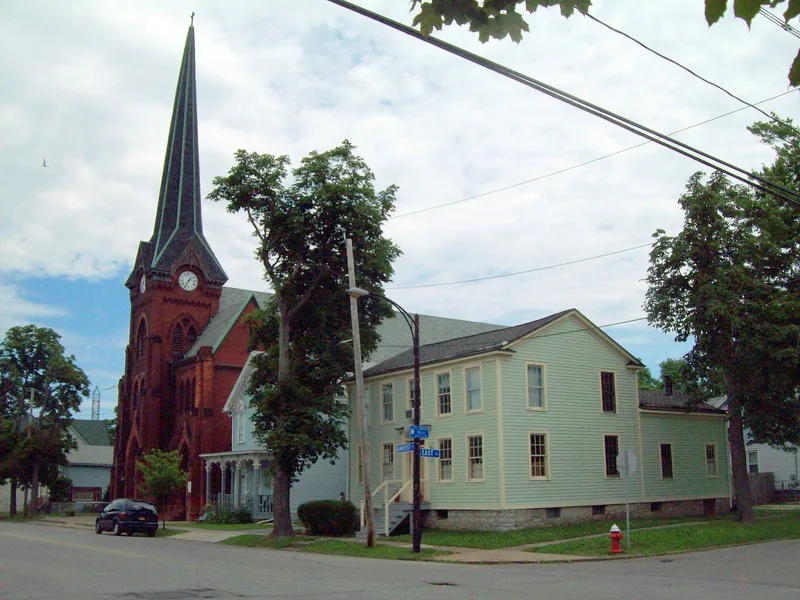
Market Square Historic District is a compact cluster of streets in Buffalo's Black Rock neighborhood, about four miles north of downtown. Its heart is a pair of grassy medians along Amherst Street, given to the community by Peter B. Porter in 1830 and used as an open public market. Around them stand two churches, a bank, a 1912 Craftsman firehouse now used as a home, and houses spanning roughly a century of building. Two of them, at 71 Amherst and 189-191 Dearborn, date to about 1830 and are among the oldest surviving homes in the Buffalo region. The district was developed as the Erie Canal, railroads and nearby industry fed a self-sufficient village center that stayed independent in spirit after joining Buffalo. It was recognized for its role in settlement and for its range of Federal, Italianate, Queen Anne, Craftsman, Gothic Revival and Romanesque architecture, preserved while surrounding blocks lost their integrity.
Machine-generated summary. This summary was generated by a language model from the official nomination document and has not been reviewed line by line by an editor. It may contain errors. Check the source document before relying on any detail. Source: nomination document (PDF) · catalog entry. Generated October 2026 (model claude-sonnet-5-5, prompt v1.0-2026-10-29).
| Period of significance | 1830 - 1912 |
|---|---|
| Styles | Early Republic/Federal; Late Victorian (Gothic, Italianate, Queen Anne, Romanesque); Late 19th and Early 20th Century American Craftsman |
| Areas of significance | Architecture, Exploration/Settlement |
| Acreage | 1.8 |
| Boundary source | not published |
| Full listing page | Market Street Historic District (property record) |
What listing means for this property
This is a historic district. Buildings within its boundary are either contributing (they add to the district's significance) or non-contributing. Owners of contributing income-producing buildings can claim the 20% federal rehabilitation tax credit; homeowners should look at state credits. National Register districts impose no design review by themselves; a local historic district ordinance, if one exists, does (the difference explained).
General information, not legal or tax advice. Rules change; confirm with your State Historic Preservation Office or a qualified adviser.