Kinderhook Village District

Why it's listed
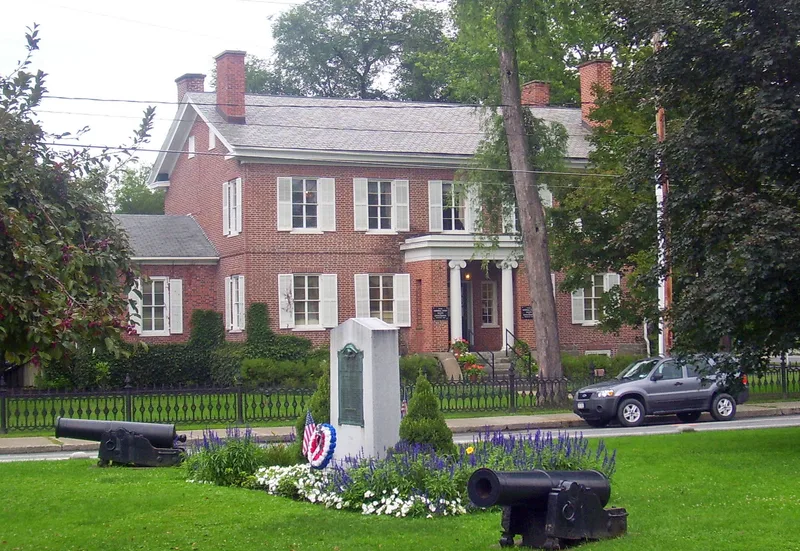
Kinderhook Village District covers the historic core of a village in Columbia County, New York, laid out along U.S. Route 9 and County Route 21 on higher ground above Kinderhook Creek. About 250 structures stand within it, roughly 200 built before the 20th century and about a dozen from the 1700s. Dutch farmers from the Albany area settled here in the 1650s and 1660s. Surviving buildings range from the Cornelius Schermerhorn House, built in sections between about 1713 and 1770, to David Van Schaack's brick house of 1774 and the Federal-style James Vanderpoel House of 1810. Greek Revival, Gothic Revival and bracketed buildings also appear, along with a livery stable, a Dutch barn, a smokehouse and a former forge. Most buildings are one to two and a half stories, giving the district a consistent scale. It was listed for the quantity and quality of its architecture and for showing how a prosperous inland farming village developed, with open fields along the creek still intact.
Machine-generated summary. This summary was generated by a language model from the official nomination document and has not been reviewed line by line by an editor. It may contain errors. Check the source document before relying on any detail. Source: nomination document (PDF) · catalog entry. Generated October 2026 (model claude-sonnet-5-5, prompt v1.0-2026-10-29).
| Period of significance | 18th and 19th centuries |
|---|---|
| Styles | Dutch colonial farmhouse and gambrel forms, neo-classical, Federal, Greek and Gothic Revival, and bracketed mid-19th century styles |
| Areas of significance | Architecture |
| Acreage | 612 |
| Boundary source | NPS cultural-resource GIS polygon |
| Full listing page | Kinderhook Village District (property record) |
What listing means for this property
This is a historic district. Buildings within its boundary are either contributing (they add to the district's significance) or non-contributing. Owners of contributing income-producing buildings can claim the 20% federal rehabilitation tax credit; homeowners should look at state credits. National Register districts impose no design review by themselves; a local historic district ordinance, if one exists, does (the difference explained).
General information, not legal or tax advice. Rules change; confirm with your State Historic Preservation Office or a qualified adviser.