Johnson Hall

Why it's listed
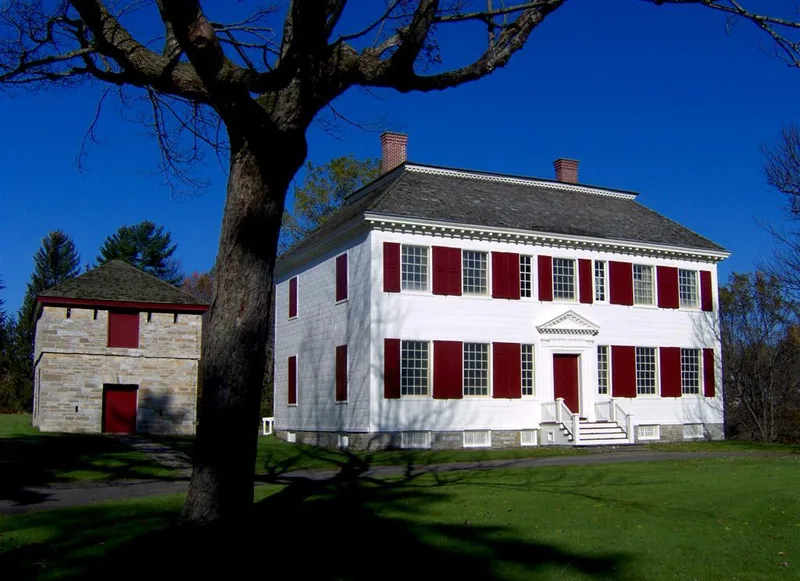
Johnson Hall is a five-bay, two-story Georgian frame house with an attic and basement, built in 1761-1762 in what is now Johnstown, New York. Housewright Lemal Baker of Schenectady constructed it, and the clapboard siding is rusticated to imitate stone blocks. Two stone blockhouses once flanked the house for protection; the western one survives and is described as the only example of its type left in New York, while the eastern one burned in 1868 and has been reconstructed after archeological work. The house was the home of Sir William Johnson, superintendent of Indian affairs for the northern colonies, for the last eleven years of his life. Treaties with the Six Nations were negotiated here, and Johnson died at the house in 1774 during a conference. The house was heavily altered in the 19th century, then restored after New York State acquired it in 1906 and again in the 1950s. An inventory of furnishings taken after his death guided the interior restoration.
Machine-generated summary. This summary was generated by a language model from the official nomination document and has not been reviewed line by line by an editor. It may contain errors. Check the source document before relying on any detail. Source: nomination document (PDF) · catalog entry. Generated October 2026 (model claude-sonnet-5-5, prompt v1.0-2026-10-29).
| Period of significance | 1761-1774 |
|---|---|
| Styles | Georgian |
| Areas of significance | Commerce, Historic - Non-Aboriginal, Exploration/Settlement, Architecture |
| Acreage | 22 |
| Boundary source | NPS cultural-resource GIS polygon |
| Full listing page | Johnson Hall (property record) |
What listing means for this property
This is a historic district. Buildings within its boundary are either contributing (they add to the district's significance) or non-contributing. Owners of contributing income-producing buildings can claim the 20% federal rehabilitation tax credit; homeowners should look at state credits. National Register districts impose no design review by themselves; a local historic district ordinance, if one exists, does (the difference explained).
General information, not legal or tax advice. Rules change; confirm with your State Historic Preservation Office or a qualified adviser.