Jefferson County Courthouse Complex

The National Park Service has not published a boundary polygon for this district; the map shows the listed properties inside it and the district's reference point.
Why it's listed
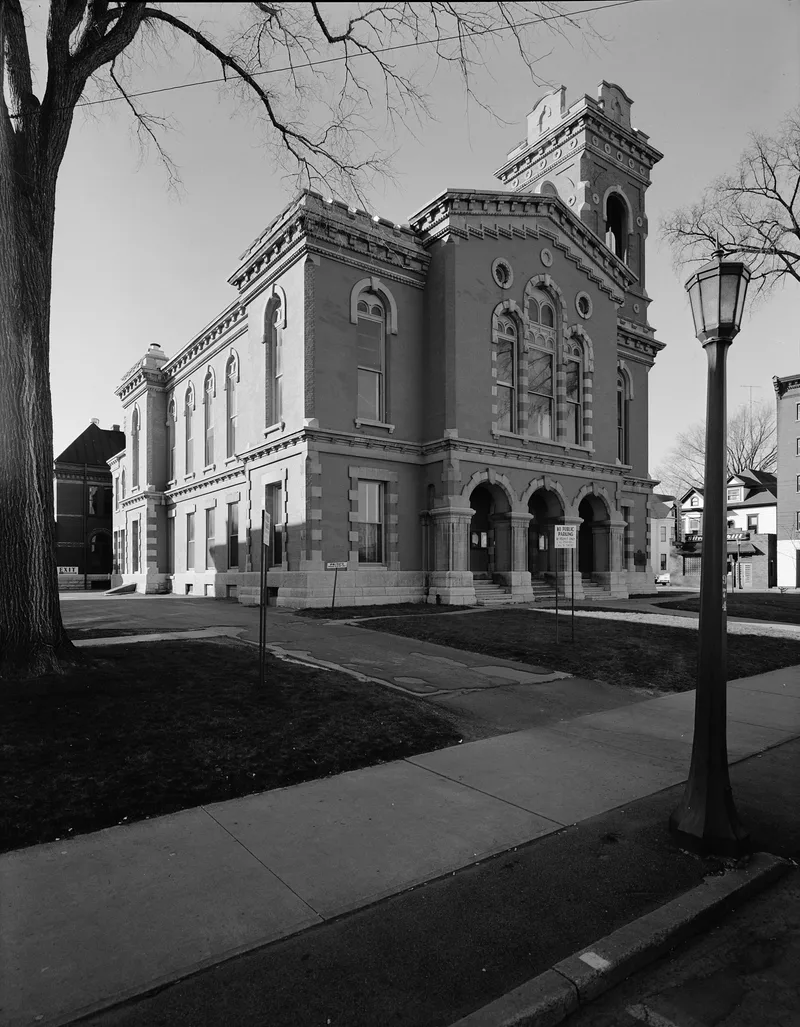
Three county buildings at the corner of Arsenal and Sherman Streets in Watertown form the Jefferson County Courthouse Complex. The centerpiece is the red brick courthouse of 1862, trimmed with limestone, with a tall second-floor courtroom and a three-story corner tower. Syracuse architect Horatio Nelson White designed it as a smaller version of his Onondaga County Courthouse, and John Hose built it after years of delay and drainage problems on a boggy site. Two later buildings sit beside it: the red brick Clerk's Office of 1884, designed by J. W. Griffin, and the greystone Surrogate's Office of 1905, designed by David Kieff. Both architects had ties to Hose, and the newer buildings repeat the courthouse's arched and lintelled window pattern and belt courses. The nomination presents the group as one of the finest clusters of county buildings in New York State. All three remain in county use, though the two smaller buildings faced threat from planned expansion.
Machine-generated summary. This summary was generated by a language model from the official nomination document and has not been reviewed line by line by an editor. It may contain errors. Check the source document before relying on any detail. Source: nomination document (PDF) · catalog entry. Generated October 2026 (model claude-sonnet-5-5, prompt v1.0-2026-10-29).
| Period of significance | 1862-1905 |
|---|---|
| Styles | Described by contemporaries as "Anglo-Norman" |
| Areas of significance | Architecture |
| Acreage | 2 |
| Boundary source | not published |
| Full listing page | Jefferson County Courthouse Complex (property record) |
What listing means for this property
This is a historic district. Buildings within its boundary are either contributing (they add to the district's significance) or non-contributing. Owners of contributing income-producing buildings can claim the 20% federal rehabilitation tax credit; homeowners should look at state credits. National Register districts impose no design review by themselves; a local historic district ordinance, if one exists, does (the difference explained).
General information, not legal or tax advice. Rules change; confirm with your State Historic Preservation Office or a qualified adviser.