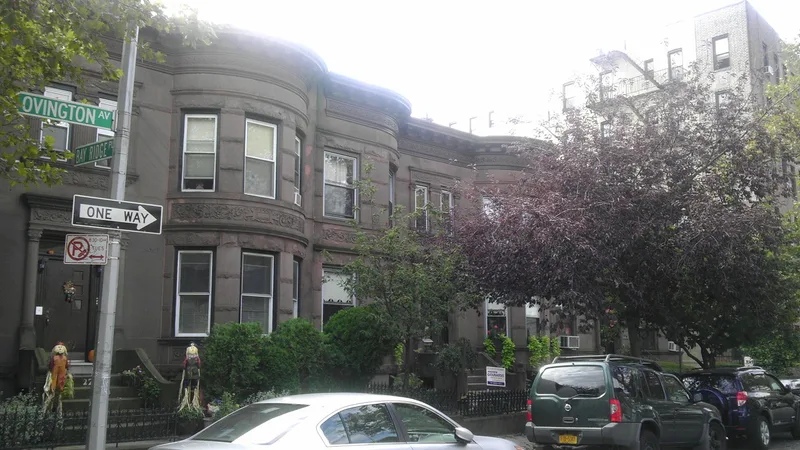
Houses at 216-264 Ovington Ave.

The National Park Service has not published a boundary polygon for this district; the map shows the listed properties inside it and the district's reference point.
Why it's listed
Twenty brownstone row houses line the south side of Ovington Avenue in Bay Ridge, Brooklyn, between Ridge Boulevard and Third Avenue. Built from 1908 to 1910 by the Silliman Construction Company, they follow the angle of the street in a stepped rhythm. The houses show Neo-Renaissance ornament, including carved garlands, swags, heraldic elements and foliage panels, along with rusticated stringcourses, metal cornices and curved bay fronts. Two designs appear: five wider houses have a center entrance between two bays, while fifteen narrower ones have a side entrance and a single bay. Brownstones are rare in Bay Ridge, and this row is one of only two complete brownstone blocks in the neighborhood. Most original windows, stoops and many interior details survive. The block is also tied to the area's suburban growth, on land once part of the Ovington family's farm and later subdivided into building lots. The houses remain residential and are well maintained.
Machine-generated summary. This summary was generated by a language model from the official nomination document and has not been reviewed line by line by an editor. It may contain errors. Check the source document before relying on any detail. Source: nomination document (PDF) · catalog entry. Generated October 2026 (model claude-sonnet-5-5, prompt v1.0-2026-10-29).
| Period of significance | 1908-1910 |
|---|---|
| Styles | Late 19th & 20th Century Revivals: Neo-Renaissance |
| Areas of significance | Architecture, Community Planning and Development |
| Acreage | 1.3 |
| Boundary source | not published |
| Full listing page | Houses at 216-264 Ovington Ave. (property record) |
What listing means for this property
This is a historic district. Buildings within its boundary are either contributing (they add to the district's significance) or non-contributing. Owners of contributing income-producing buildings can claim the 20% federal rehabilitation tax credit; homeowners should look at state credits. National Register districts impose no design review by themselves; a local historic district ordinance, if one exists, does (the difference explained).
General information, not legal or tax advice. Rules change; confirm with your State Historic Preservation Office or a qualified adviser.