Home of Franklin D. Roosevelt National Historic Site

Why it's listed
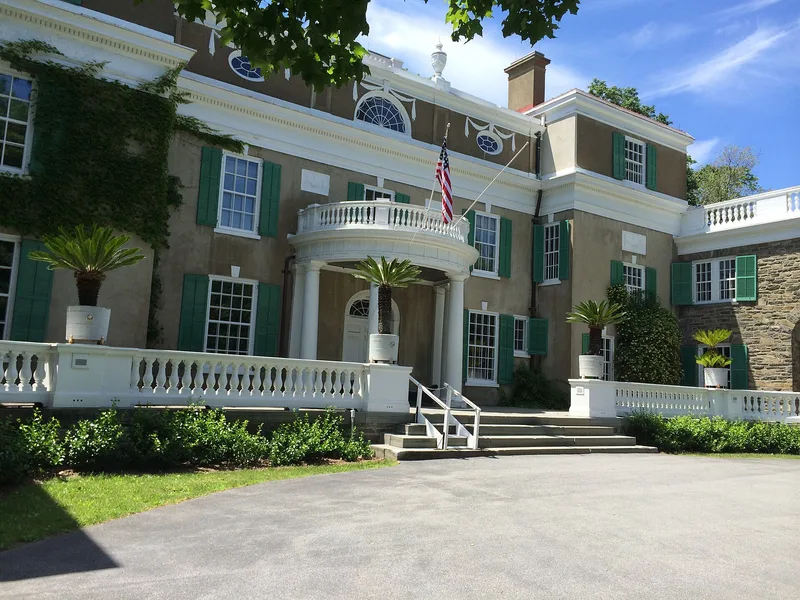
Springwood, the Roosevelt family estate at Hyde Park, New York, overlooks the Hudson River and forms the core of a 264.51-acre historic site. The house began as a two-story farmhouse built between 1790 and 1805, then grew through additions by successive owners. In 1915 Franklin Roosevelt and his mother had it stuccoed, added a matching north tower and stone wings, with architects Hoppin and Koen giving it a unified Federal-style look. Around it stand a Queen Anne coach house, greenhouse, ice houses, a Carpenter Gothic gardener's cottage, and a rose garden near the graves of Franklin and Eleanor Roosevelt. The adjoining Bellefield estate, remodeled by McKim, Mead and White between 1909 and 1911, now serves as park headquarters. The site matters because it is the only place where a President was born, grew up, and is buried. It was also where Roosevelt worked to recover from polio, and he asked that the view of the Hudson be protected.
Machine-generated summary. This summary was generated by a language model from the official nomination document and has not been reviewed line by line by an editor. It may contain errors. Check the source document before relying on any detail. Source: nomination document (PDF) · catalog entry. Generated October 2026 (model claude-sonnet-5-5, prompt v1.0-2026-10-29).
| Styles | Federal origins with 1915 Federal-style makeover (Springwood); Queen Anne (Coach House); Carpenter Gothic (Gardener's Cottage); Colonial Revival (Bellefield) |
|---|---|
| Areas of significance | Politics/Government, Architecture |
| Acreage | 264.5 |
| Boundary source | NPS cultural-resource GIS polygon |
| Full listing page | Home of Franklin D. Roosevelt National Historic Site (property record) |
What listing means for this property
This is a historic district. Buildings within its boundary are either contributing (they add to the district's significance) or non-contributing. Owners of contributing income-producing buildings can claim the 20% federal rehabilitation tax credit; homeowners should look at state credits. National Register districts impose no design review by themselves; a local historic district ordinance, if one exists, does (the difference explained).
General information, not legal or tax advice. Rules change; confirm with your State Historic Preservation Office or a qualified adviser.