Gramercy Park Historic District

The National Park Service has not published a boundary polygon for this district; the map shows the listed properties inside it and the district's reference point.
Why it's listed
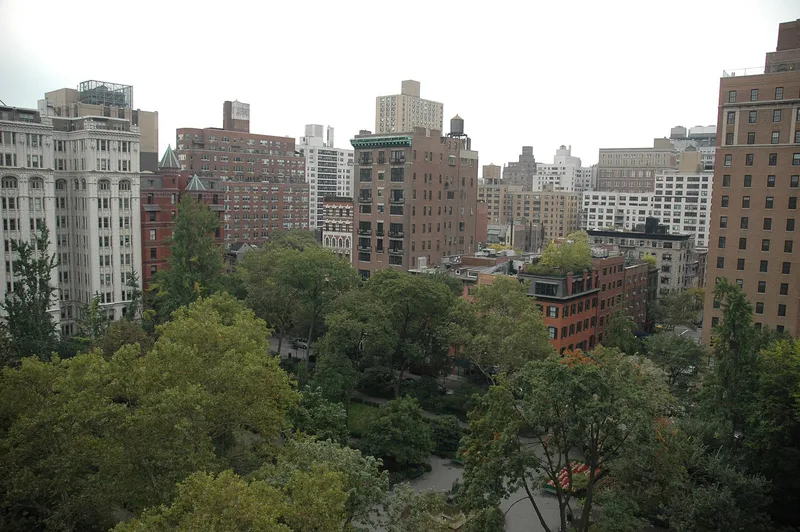
Gramercy Park Historic District is a residential neighborhood of fewer than ten blocks in Manhattan, built around a private, fenced square measuring about 520 by 184 feet. Lawyer and real estate operator Samuel B. Ruggles bought the marshy land in 1831 and laid out sixty-six lots around the park, whose care fell to the lot owners. Houses began rising in the 1840s, and Irving Place and Lexington Avenue were cut through to improve access. The district contains Greek Revival, Italianate, Gothic Revival and later styles, with low, fairly uniform building heights, wrought iron, small front gardens and tree-lined streets. Notable buildings include the National Arts Club, remodelled by Calvert Vaux in 1874, the Players Club, with Stanford White's 1888 portico, and Calvary Church, designed by James Renwick, Jr. in 1846. Residents included Samuel Tilden and the actor Edwin Booth. It is described as the only privately maintained park in the city and an early example of town planning.
Machine-generated summary. This summary was generated by a language model from the official nomination document and has not been reviewed line by line by an editor. It may contain errors. Check the source document before relying on any detail. Source: nomination document (PDF) · catalog entry. Generated October 2026 (model claude-sonnet-5-5, prompt v1.0-2026-10-29).
| Period of significance | 1800-1899, 1900- |
|---|---|
| Styles | Anglo-Italianate, Greek Revival, Gothic Revival, Italianate, Victorian Gothic, Perpendicular Gothic, Venetian Gothic |
| Areas of significance | Landscape Architecture, Architecture |
| Acreage | 0.9 |
| Boundary source | not published |
| Full listing page | Gramercy Park Historic District (property record) |
What listing means for this property
This is a historic district. Buildings within its boundary are either contributing (they add to the district's significance) or non-contributing. Owners of contributing income-producing buildings can claim the 20% federal rehabilitation tax credit; homeowners should look at state credits. National Register districts impose no design review by themselves; a local historic district ordinance, if one exists, does (the difference explained).
General information, not legal or tax advice. Rules change; confirm with your State Historic Preservation Office or a qualified adviser.