Gansevoort-Bellamy Historic District

Why it's listed
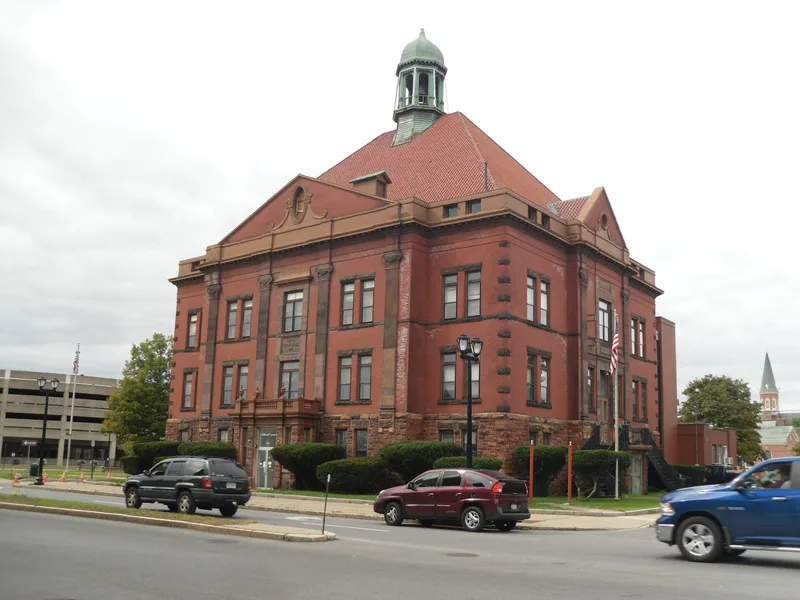
Two adjacent parks in central Rome, Gansevoort and Bellamy, form the core of this district, along with the buildings that face them. Dominick Lynch, the founder of Rome, set the land aside as a public square in 1800 and envisioned it as the community's governmental center. Later courthouse, city hall, post office and justice facility construction fulfilled that idea. The district includes the 1851 Oneida County Courthouse with its Ionic portico and dome, the 1853 First Presbyterian Church, the Romanesque St. Peter's Roman Catholic Church of 1895-97, the 1894 Flemish Revival City Hall, the 1936 Post Office, and the 1961 Justice Building. A row of nineteenth century houses marks the western edge of the plaza. Statues of General Peter Gansevoort and a war memorial stand in the parks. The district adjoins the Fort Stanwix reconstruction, and Rome's city government has protected the area with zoning controls.
Machine-generated summary. This summary was generated by a language model from the official nomination document and has not been reviewed line by line by an editor. It may contain errors. Check the source document before relying on any detail. Source: nomination document (PDF) · catalog entry. Generated October 2026 (model claude-sonnet-5-5, prompt v1.0-2026-10-29).
| Period of significance | 19th and 20th centuries (specific dates not given) |
|---|---|
| Styles | Greek Revival, Romanesque Revival, Flemish Revival, Georgian Revival, Late Greek with Egyptian influence, and Contemporary |
| Areas of significance | Architecture |
| Boundary source | NPS cultural-resource GIS polygon |
| Full listing page | Gansevoort-Bellamy Historic District (property record) |
What listing means for this property
This is a historic district. Buildings within its boundary are either contributing (they add to the district's significance) or non-contributing. Owners of contributing income-producing buildings can claim the 20% federal rehabilitation tax credit; homeowners should look at state credits. National Register districts impose no design review by themselves; a local historic district ordinance, if one exists, does (the difference explained).
General information, not legal or tax advice. Rules change; confirm with your State Historic Preservation Office or a qualified adviser.