Fredonia Commons Historic District

Why it's listed
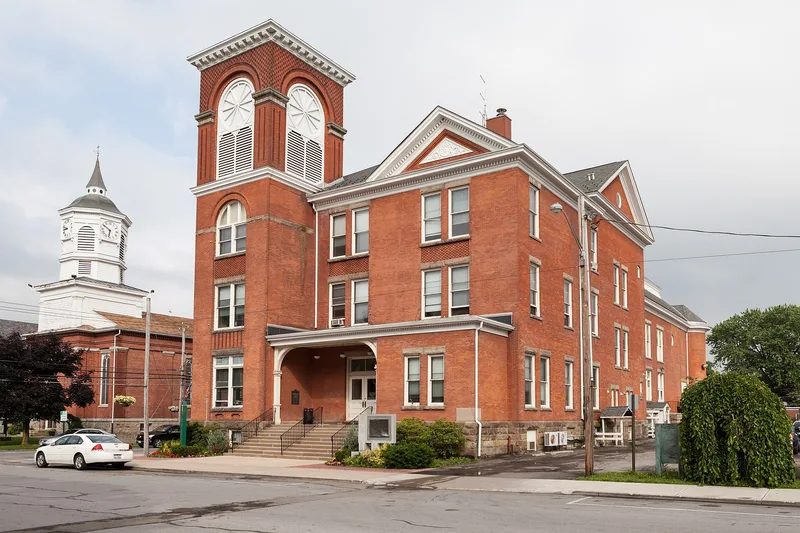
Fredonia's Commons is a village green surrounded by the buildings that have long served as the town's center. The historic district covers about twenty-five structures, including the fire station, village hall, post office, library, three churches and a continuous wall of commercial blocks along Main Street. The layout follows the New England pattern of a central green with civic, religious and commercial buildings grouped around it. Hezekiah Barker, who settled in 1806, laid out the village lots and set aside the Commons, deeding it to the Town of Pomfret in 1825. The Fredonia Academy, founded in 1823, and its successor institutions made education a lasting part of village life. Architecture ranges from the Gothic Revival Trinity Episcopal Church of 1834-35 and the Baptist Church of 1852-53 to Italianate storefronts, a Second Empire lodge building and an early twentieth century International Modern building. The district was listed for its architecture and its record of the village's development.
Machine-generated summary. This summary was generated by a language model from the official nomination document and has not been reviewed line by line by an editor. It may contain errors. Check the source document before relying on any detail. Source: nomination document (PDF) · catalog entry. Generated October 2026 (model claude-sonnet-5-5, prompt v1.0-2026-10-29).
| Styles | Mixed: Federal, Gothic Revival, Greek Revival, Queen Anne, Italianate, Second Empire and International Modern |
|---|---|
| Areas of significance | Community Planning and Development, Commerce, Education, Politics/Government, Architecture |
| Acreage | 10.5 |
| Boundary source | NPS cultural-resource GIS polygon |
| Full listing page | Fredonia Commons Historic District (property record) |
What listing means for this property
This is a historic district. Buildings within its boundary are either contributing (they add to the district's significance) or non-contributing. Owners of contributing income-producing buildings can claim the 20% federal rehabilitation tax credit; homeowners should look at state credits. National Register districts impose no design review by themselves; a local historic district ordinance, if one exists, does (the difference explained).
General information, not legal or tax advice. Rules change; confirm with your State Historic Preservation Office or a qualified adviser.