Fraunces Tavern Block

The National Park Service has not published a boundary polygon for this district; the map shows the listed properties inside it and the district's reference point.
Why it's listed
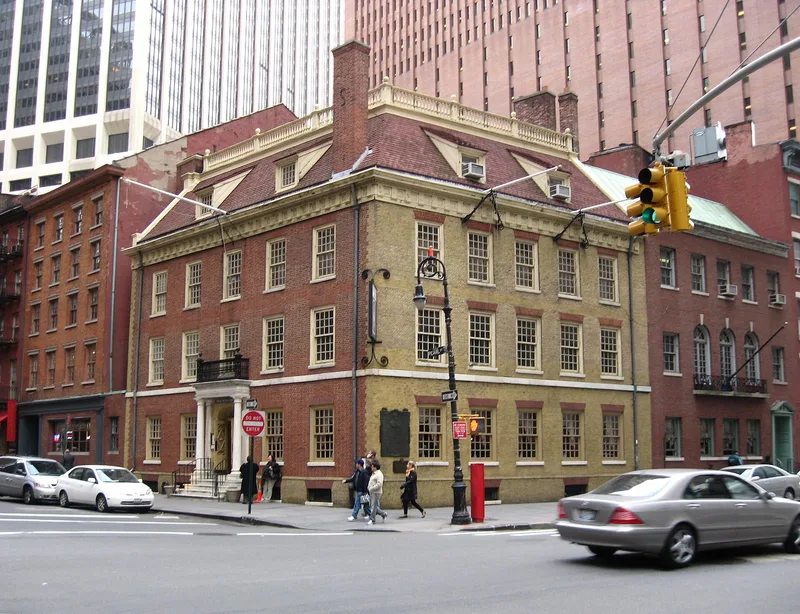
Sixteen brick and stone buildings from the 18th and 19th centuries make up this block in Lower Manhattan, bounded by Pearl, Water and Broad Streets and Coenties Slip. Fraunces Tavern, at the corner of Broad and Pearl Streets, gives the block its name. It was heavily reconstructed in 1907 and now holds a restaurant and a museum devoted to George Washington and the Revolutionary War. The land was granted to the Van Cortlandt family around 1686, and Stephen de Lancey built a house here in 1719 that Samuel Fraunces bought in 1763. As harbor commerce grew, the former houses became stores, factories and warehouses, and Pearl Street was widened in the 1820s. The surviving buildings show granite piers, carved capitals, brick upper stories and uniform cornice lines. Their small scale stands in sharp contrast to the surrounding office towers. The block is valued as a cohesive streetscape and as a rare record of the old seaport.
Machine-generated summary. This summary was generated by a language model from the official nomination document and has not been reviewed line by line by an editor. It may contain errors. Check the source document before relying on any detail. Source: nomination document (PDF) · catalog entry. Generated October 2026 (model claude-sonnet-5-5, prompt v1.0-2026-10-29).
| Styles | Georgian, Federal, Greek Revival and Victorian |
|---|---|
| Areas of significance | Architecture |
| Acreage | 0.5 |
| Boundary source | not published |
| Full listing page | Fraunces Tavern Block (property record) |
What listing means for this property
This is a historic district. Buildings within its boundary are either contributing (they add to the district's significance) or non-contributing. Owners of contributing income-producing buildings can claim the 20% federal rehabilitation tax credit; homeowners should look at state credits. National Register districts impose no design review by themselves; a local historic district ordinance, if one exists, does (the difference explained).
General information, not legal or tax advice. Rules change; confirm with your State Historic Preservation Office or a qualified adviser.