Fort Plain Historic District (Boundary Increase)

The National Park Service has not published a boundary polygon for this district; the map shows the listed properties inside it and the district's reference point.
Why it's listed
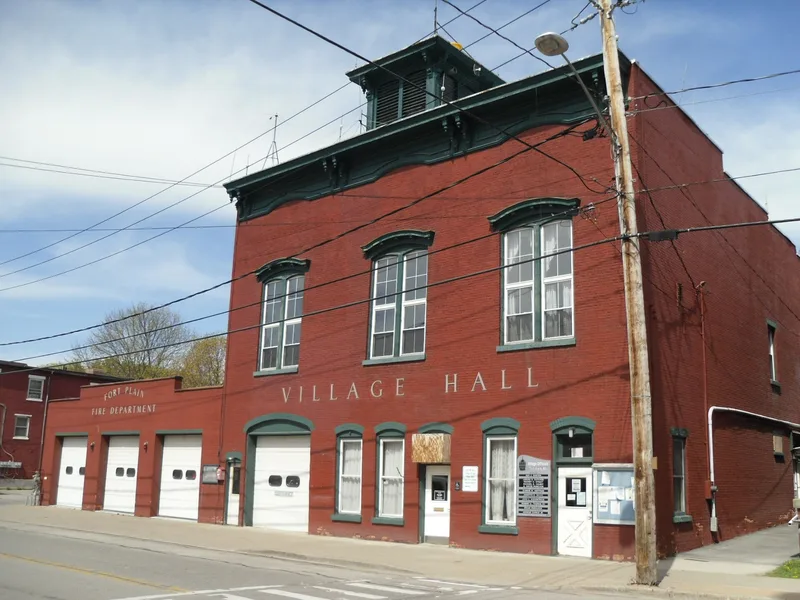
Fort Plain Historic District takes in most of the Montgomery County village that grew up beside the Erie Canal and the Mohawk River, at the mouth of Otsquago Creek. Its street plan was laid out in anticipation of the canal and still follows an early grid, superimposed on older, narrow river-front farm lots. The district holds 539 contributing resources, mostly buildings. Canal Street keeps a row of three-story warehouses and storefronts, while Main Street and Willett Street preserve evidence of water-powered and steam-powered industry, including the Red Mill and a brick axle and spring works. Churches from the 1870s to about 1900, an Italianate village hall, a 1915 Beaux-Arts high school and a hilltop cemetery add to the mix. Houses range from the 1786 Isaac Paris house to Federal, Greek Revival, Gothic Revival, Italianate and Queen Anne examples, including a Queen Anne neighborhood on Prospect Street. Local limestone appears in foundations and in surviving canal fragments. The former canal route is now State Street.
Machine-generated summary. This summary was generated by a language model from the official nomination document and has not been reviewed line by line by an editor. It may contain errors. Check the source document before relying on any detail. Source: nomination document (PDF) · catalog entry. Generated October 2026 (model claude-sonnet-5-5, prompt v1.0-2026-10-29).
| Styles | Various (Federal, Greek Revival, Gothic Revival, Italianate, Queen Anne, Beaux-Arts and others) |
|---|---|
| Areas of significance | Architecture, Community Planning and Development, Commerce, Transportation |
| Acreage | 216.96 |
| Boundary source | not published |
| Full listing page | Fort Plain Historic District (Boundary Increase) (property record) |
What listing means for this property
This is a historic district. Buildings within its boundary are either contributing (they add to the district's significance) or non-contributing. Owners of contributing income-producing buildings can claim the 20% federal rehabilitation tax credit; homeowners should look at state credits. National Register districts impose no design review by themselves; a local historic district ordinance, if one exists, does (the difference explained).
General information, not legal or tax advice. Rules change; confirm with your State Historic Preservation Office or a qualified adviser.