Fort Ontario

Why it's listed
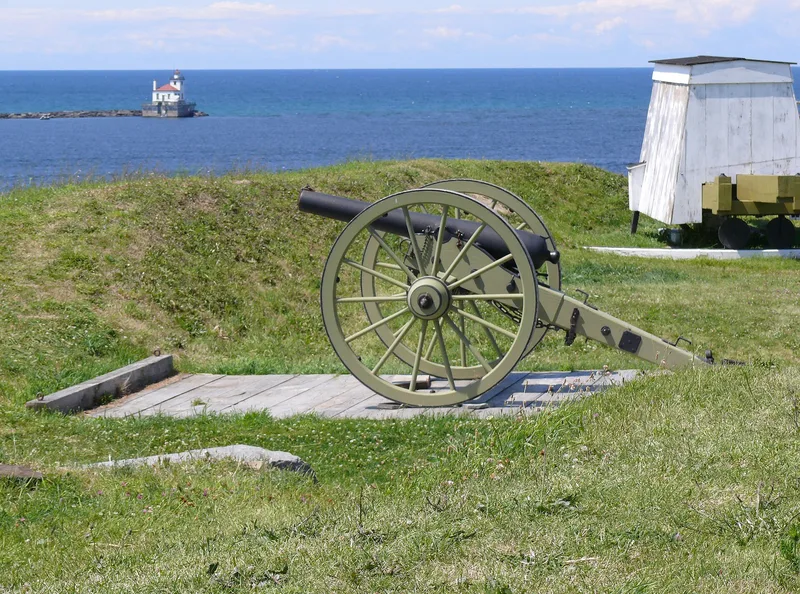
Fort Ontario is a pentagonal stone fortification on the shore of Lake Ontario in Oswego, New York. Five arrow-shaped bastions mark its corners, and an irregular oval courtyard holds the powder magazine, officers' quarters and post headquarters. The cut-stone walls date from 1860, while the interior buildings are stone, wood and brick. The powder magazine was built between 1839 and 1844, and the west artillery casemate holds a battery of 24 and 32 pound howitzers. The site has hosted three forts. The British built the first in 1755 to challenge the French, and it was destroyed in 1756. A stronger second fort followed in 1759, was used in the Revolutionary War and the War of 1812, and was captured and destroyed in 1814. The third fort began in 1839 during tensions over Canada's Patriot War and was upgraded in 1860. It later served as a training post, a World War I hospital camp and a World War II training installation. The Army left in 1946, and the fort became a museum property.
Machine-generated summary. This summary was generated by a language model from the official nomination document and has not been reviewed line by line by an editor. It may contain errors. Check the source document before relying on any detail. Source: nomination document (PDF) · catalog entry. Generated October 2026 (model claude-sonnet-5-5, prompt v1.0-2026-10-29).
| Areas of significance | Military, Social History |
|---|---|
| Acreage | 62.75 |
| Boundary source | NPS cultural-resource GIS polygon |
| Full listing page | Fort Ontario (property record) |
What listing means for this property
This is a historic district. Buildings within its boundary are either contributing (they add to the district's significance) or non-contributing. Owners of contributing income-producing buildings can claim the 20% federal rehabilitation tax credit; homeowners should look at state credits. National Register districts impose no design review by themselves; a local historic district ordinance, if one exists, does (the difference explained).
General information, not legal or tax advice. Rules change; confirm with your State Historic Preservation Office or a qualified adviser.