First Old School Baptist Church of Roxbury and Vega Cemetery

Why it's listed
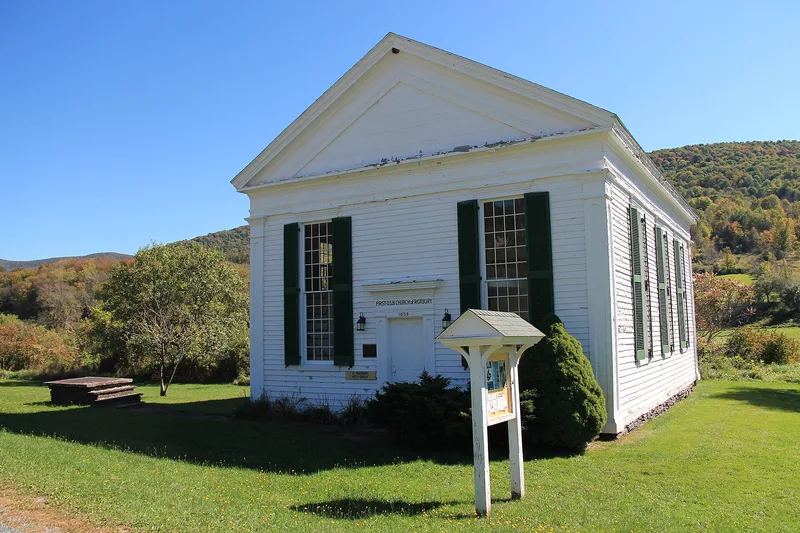
Along County Route 36 in the Catskill hamlet of Vega, a small white meeting house and an adjoining burial ground mark the home of the First Old School Baptist congregation of Roxbury. The front-gabled, wood-framed church was built in 1856 and shows restrained Greek Revival detail: a plain entablature, corner pilasters and a pedimented west facade. Inside are a shallow vestibule with curved gallery stairs, a plain meeting room, a U-shaped gallery and simple bench pews. The nearby creek served for baptisms by immersion. The Vega Cemetery holds early nineteenth-century marble stones and graves of congregation elders and members of the wider community. The congregation traces its origin to a Baptist church organized in 1796, reputedly the first in the town, and later aligned with the Old School faction opposed to centralized missionary organization. The district is recognized for preserving a nearly unaltered rural religious setting.
Machine-generated summary. This summary was generated by a language model from the official nomination document and has not been reviewed line by line by an editor. It may contain errors. Check the source document before relying on any detail. Source: nomination document (PDF) · catalog entry. Generated October 2026 (model claude-sonnet-5-5, prompt v1.0-2026-10-29).
| Styles | Mid-19th Century, Greek Revival |
|---|---|
| Areas of significance | Architecture, Religion, Community Planning and Development |
| Acreage | 4 |
| Boundary source | NPS cultural-resource GIS polygon |
| Full listing page | First Old School Baptist Church of Roxbury and Vega Cemetery (property record) |
What listing means for this property
This is a historic district. Buildings within its boundary are either contributing (they add to the district's significance) or non-contributing. Owners of contributing income-producing buildings can claim the 20% federal rehabilitation tax credit; homeowners should look at state credits. National Register districts impose no design review by themselves; a local historic district ordinance, if one exists, does (the difference explained).
General information, not legal or tax advice. Rules change; confirm with your State Historic Preservation Office or a qualified adviser.