East Main Street Commercial Historic District

The National Park Service has not published a boundary polygon for this district; the map shows the listed properties inside it and the district's reference point.
Why it's listed
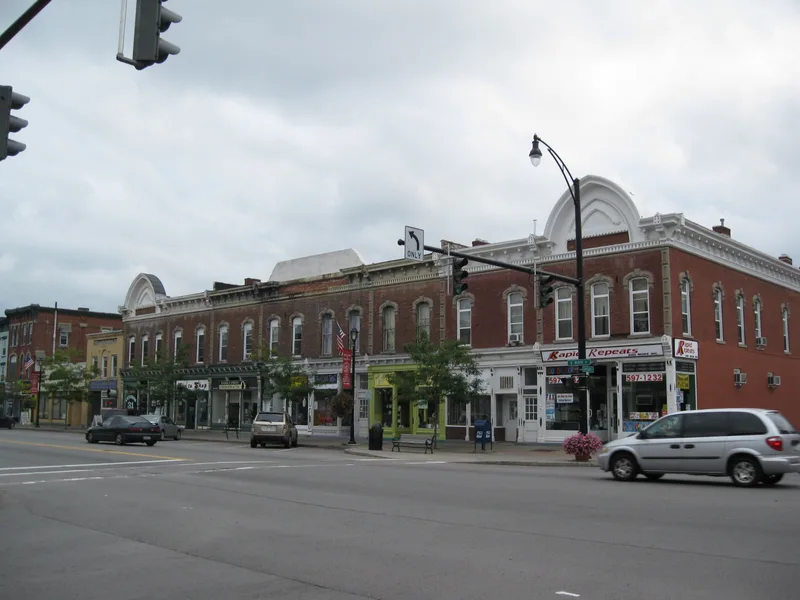
Two blocks of East Main Street in Palmyra, New York, form a downtown commercial district of nearly continuous brick storefronts, two and three stories high. Many retain cast iron fronts marked by Rochester and local foundries. Prominent buildings include the Cuyler Block and Jarvis Block, both of 1876 according to the description, the Jenner Block, the Williams and Williamson Blocks, and the former Palmyra Hotel, built in 1836-37 with a two-story gabled portico. A few houses stand at the east end, including the home said to have been built by Pliny Sexton in 1827. The district matters because it shows how stagecoach, railroad and canal traffic produced a solid commercial village in the mid-1800s. Early blocks were remodelled in the 1860s with decorative hoods and cornices, and later blocks followed. The area is also tied to the first printings of the Book of Mormon and to Sexton, a hardware merchant and anti-slavery supporter. Some 1920s buildings were added later.
Machine-generated summary. This summary was generated by a language model from the official nomination document and has not been reviewed line by line by an editor. It may contain errors. Check the source document before relying on any detail. Source: nomination document (PDF) · catalog entry. Generated October 2026 (model claude-sonnet-5-5, prompt v1.0-2026-10-29).
| Period of significance | 19th and 20th centuries (no specific date range given) |
|---|---|
| Areas of significance | Commerce, Architecture |
| Acreage | 6 |
| Boundary source | not published |
| Full listing page | East Main Street Commercial Historic District (property record) |
What listing means for this property
This is a historic district. Buildings within its boundary are either contributing (they add to the district's significance) or non-contributing. Owners of contributing income-producing buildings can claim the 20% federal rehabilitation tax credit; homeowners should look at state credits. National Register districts impose no design review by themselves; a local historic district ordinance, if one exists, does (the difference explained).
General information, not legal or tax advice. Rules change; confirm with your State Historic Preservation Office or a qualified adviser.