Dryden Historic District

Why it's listed
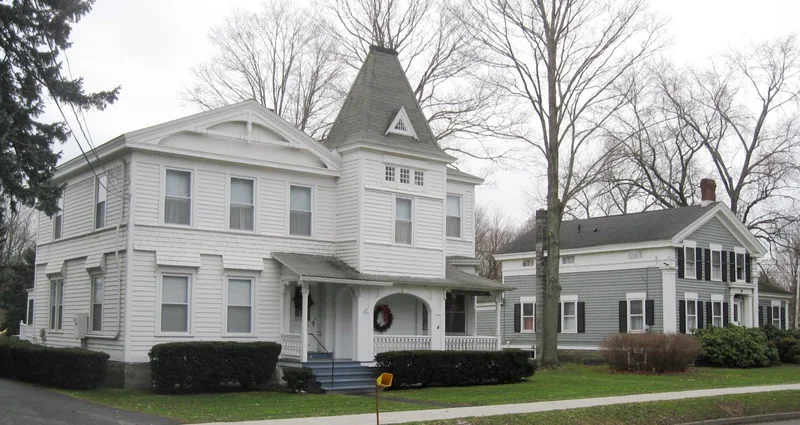
Dryden Historic District covers forty-four properties in the village of Dryden, Tompkins County, New York. It is anchored by the "four corners" where East Main and South Streets meet, and it extends into the "Square," a neighborhood subdivided and built up from the 1850s with the opening of James and Pleasant Streets. Three mid-nineteenth century commercial buildings stand at the crossroads, and tree-lined residential streets make up the rest. Most buildings are frame houses built between 1800 and 1905, and all but four contribute to the district. The houses show Federal, Greek Revival, Gothic Revival, Italianate, Second Empire, Victorian Gothic and Queen Anne styles, many with their original barns. Together they record Dryden's shift from a lumbering community in the 1820s and 1830s to a manufacturing town in the 1840s to 1860s and then an agricultural market town. They range from fine homes of entrepreneurs to modest working-class dwellings.
Machine-generated summary. This summary was generated by a language model from the official nomination document and has not been reviewed line by line by an editor. It may contain errors. Check the source document before relying on any detail. Source: nomination document (PDF) · catalog entry. Generated October 2026 (model claude-sonnet-5-5, prompt v1.0-2026-10-29).
| Styles | Federal, Greek Revival, Gothic Revival, Italianate, Second Empire, Victorian Gothic, Queen Anne, and vernacular variants |
|---|---|
| Areas of significance | Architecture |
| Acreage | 20 |
| Boundary source | NPS cultural-resource GIS polygon |
| Full listing page | Dryden Historic District (property record) |
What listing means for this property
This is a historic district. Buildings within its boundary are either contributing (they add to the district's significance) or non-contributing. Owners of contributing income-producing buildings can claim the 20% federal rehabilitation tax credit; homeowners should look at state credits. National Register districts impose no design review by themselves; a local historic district ordinance, if one exists, does (the difference explained).
General information, not legal or tax advice. Rules change; confirm with your State Historic Preservation Office or a qualified adviser.