Delaware County Courthouse Square District

The National Park Service has not published a boundary polygon for this district; the map shows the listed properties inside it and the district's reference point.
Why it's listed
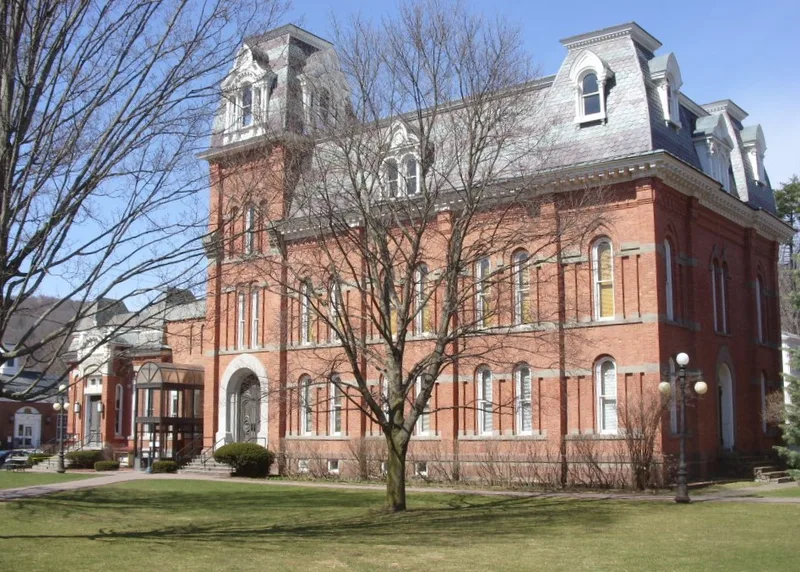
Delhi's courthouse square is a compact grouping of 19th century government, commercial and religious buildings arranged around an open village green. The two and a half story red brick courthouse dominates the space, with a mansard slate roof, a four story entrance tower, elaborate dormers and ornate brickwork. Isaac G. Perry designed it after county supervisors voted in 1868 to replace an earlier wood frame courthouse, and local voters pledged funds to keep the county seat in Delhi. Nearby stand the sheriff's office and jail, a bandstand, a former courthouse now used as village offices and a fire hall, and a church and bank designed by Charles Hathaway in 1831 and 1838. Surrounding commercial buildings are mostly two or three story clapboard structures. The district is valued as a typical small town courthouse square whose architectural integrity has been remarkably preserved, reflecting the village's growth and its long role as county seat.
Machine-generated summary. This summary was generated by a language model from the official nomination document and has not been reviewed line by line by an editor. It may contain errors. Check the source document before relying on any detail. Source: nomination document (PDF) · catalog entry. Generated October 2026 (model claude-sonnet-5-5, prompt v1.0-2026-10-29).
| Period of significance | 19th Century |
|---|---|
| Styles | Greek Revival elements noted on the bank building; courthouse has a mansard roof and ornate brickwork |
| Areas of significance | Politics/Government, Architecture |
| Acreage | 8 |
| Boundary source | not published |
| Full listing page | Delaware County Courthouse Square District (property record) |
What listing means for this property
This is a historic district. Buildings within its boundary are either contributing (they add to the district's significance) or non-contributing. Owners of contributing income-producing buildings can claim the 20% federal rehabilitation tax credit; homeowners should look at state credits. National Register districts impose no design review by themselves; a local historic district ordinance, if one exists, does (the difference explained).
General information, not legal or tax advice. Rules change; confirm with your State Historic Preservation Office or a qualified adviser.