Covert Historic District

Why it's listed
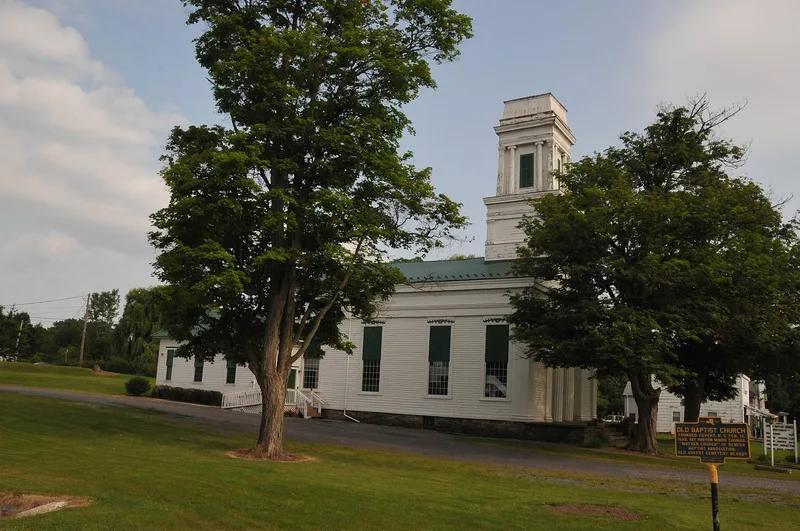
Covert is a small farming hamlet in southeastern Seneca County, New York, where twenty-one properties line a stretch of Route 96 about eight-tenths of a mile long. Once known as Pratt's Corners, it began as a crossroads community with a tavern and general store. Settlement in the town dates to 1788, when military lots were granted to Revolutionary War veterans. Most growth came between 1810 and 1860, and the buildings show it: timber-framed, clapboard Greek Revival houses predominate, alongside Federal and Gothic Revival examples. Notable buildings include the Pratt Tavern, built before 1810, Colonel Chauncey Pratt's brick house of 1835, the 1848 Town Hall, and the Baptist church of about 1850. Wheat farming exhausted the soil by the 1850s, and the hamlet's distance from canals and railroads halted expansion. As a result, Covert kept its nineteenth-century scale, barns and open farmland, and it has no modern intrusions.
Machine-generated summary. This summary was generated by a language model from the official nomination document and has not been reviewed line by line by an editor. It may contain errors. Check the source document before relying on any detail. Source: nomination document (PDF) · catalog entry. Generated October 2026 (model claude-sonnet-5-5, prompt v1.0-2026-10-29).
| Period of significance | 1800-1899, 1900- |
|---|---|
| Styles | Greek Revival, with Federal, transitional Federal-Greek Revival, Gothic Revival and Stick style elements |
| Areas of significance | Architecture |
| Acreage | 0.4 |
| Boundary source | NPS cultural-resource GIS polygon |
| Full listing page | Covert Historic District (property record) |
What listing means for this property
This is a historic district. Buildings within its boundary are either contributing (they add to the district's significance) or non-contributing. Owners of contributing income-producing buildings can claim the 20% federal rehabilitation tax credit; homeowners should look at state credits. National Register districts impose no design review by themselves; a local historic district ordinance, if one exists, does (the difference explained).
General information, not legal or tax advice. Rules change; confirm with your State Historic Preservation Office or a qualified adviser.