Clayton Historic District

The National Park Service has not published a boundary polygon for this district; the map shows the listed properties inside it and the district's reference point.
Why it's listed
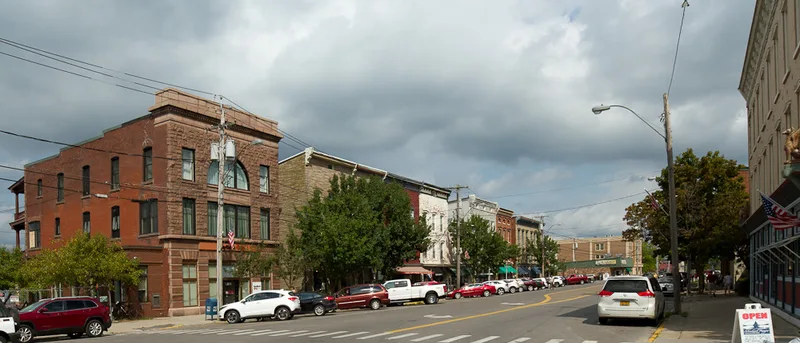
Clayton's main commercial blocks, along Riverside Drive and the north end of James Street on the St. Lawrence River, form a district of thirty-one contributing buildings dating from 1854 to the 1920s. Most are two- and three-story attached rows with ground-floor shops and upper-floor residences or storage. Italianate brick and wood buildings predominate, joined by three Richardsonian Romanesque stone-faced buildings and some early twentieth century concrete block and wood structures. The earliest survivor is the 1854 Barker Building, which keeps two cast-iron storefronts and set the scale for its neighbors. The streetscape took shape through commercial growth tied to shipping, lumbering, farming and Thousand Islands tourism, and through rebuilding after fires in 1853, 1856, 1887 and 1895. Although many storefronts have been altered, pressed-metal cornices and window crowns above them remain. Little new construction since the 1920s has left a cohesive main street of a kind rarely preserved in the region. A c.1932 gas station is the only non-contributing building.
Machine-generated summary. This summary was generated by a language model from the official nomination document and has not been reviewed line by line by an editor. It may contain errors. Check the source document before relying on any detail. Source: nomination document (PDF) · catalog entry. Generated October 2026 (model claude-sonnet-5-5, prompt v1.0-2026-10-29).
| Period of significance | 1854-1920's |
|---|---|
| Styles | Italianate, with Richardsonian Romanesque buildings and early twentieth century commercial buildings |
| Areas of significance | Architecture |
| Acreage | 4.7 |
| Boundary source | not published |
| Full listing page | Clayton Historic District (property record) |
What listing means for this property
This is a historic district. Buildings within its boundary are either contributing (they add to the district's significance) or non-contributing. Owners of contributing income-producing buildings can claim the 20% federal rehabilitation tax credit; homeowners should look at state credits. National Register districts impose no design review by themselves; a local historic district ordinance, if one exists, does (the difference explained).
General information, not legal or tax advice. Rules change; confirm with your State Historic Preservation Office or a qualified adviser.