Chenango County Courthouse District

Why it's listed
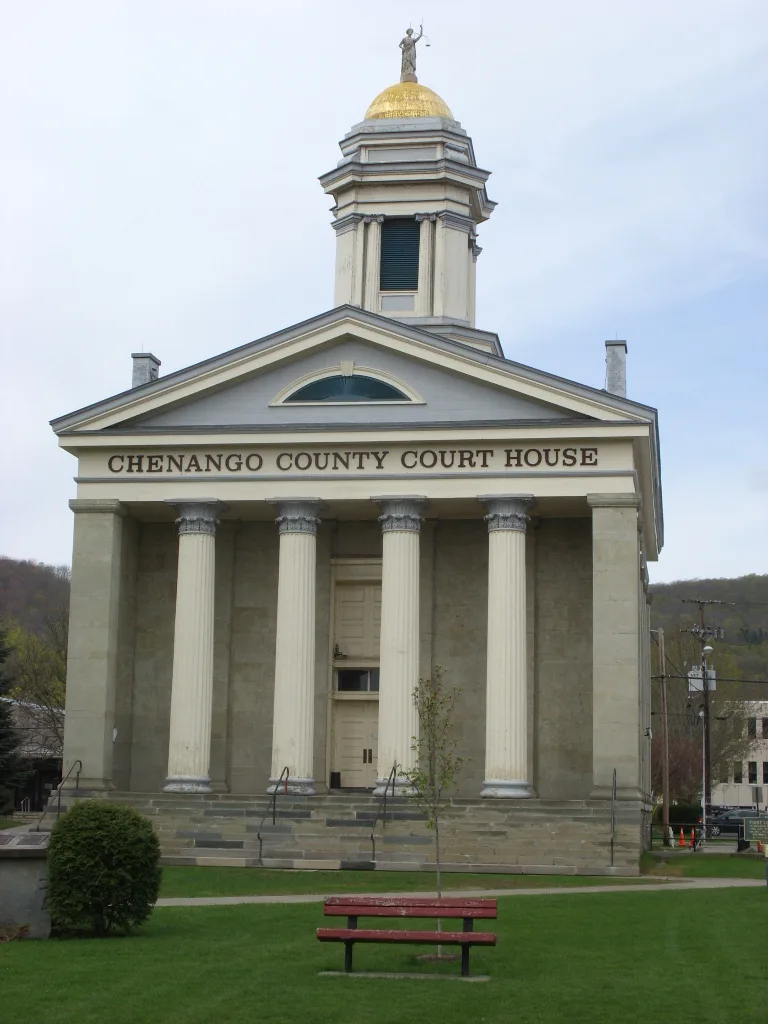
Centered on the crossing of Broad and Main Streets in Norwich, this district gathers two village greens, the county courthouse, city hall, churches, a Masonic temple and rows of mostly brick commercial buildings. The gray stone courthouse of 1837, with its Ionic portico and cupola, faces East Park and sits beside Greek Revival county offices. The 1878 Masonic Temple, five stories with a mansard roof and cast iron storefront, is the tallest building. The 1861 Congregational Church replaced one lost to fire in 1858. Norwich grew as a county seat after 1807 and then as an industrial town after the Chenango Canal opened around 1833, with piano making, ironworks, carriages and pharmaceuticals. That prosperity produced a cross section of nineteenth-century styles. The greens, laid out by New England settlers, reflect a familiar town plan. About one sixth of the buildings are modern intrusions, and many ground floors have been altered, though upper stories remain largely intact.
Machine-generated summary. This summary was generated by a language model from the official nomination document and has not been reviewed line by line by an editor. It may contain errors. Check the source document before relying on any detail. Source: nomination document (PDF) · catalog entry. Generated October 2026 (model claude-sonnet-5-5, prompt v1.0-2026-10-29).
| Styles | Greek Revival (courthouse group), with Gothic, mansard-roofed and commercial nineteenth-century styles |
|---|---|
| Areas of significance | Community Planning and Development, Politics/Government, Architecture |
| Acreage | 19.8 |
| Boundary source | NPS cultural-resource GIS polygon |
| Full listing page | Chenango County Courthouse District (property record) |
What listing means for this property
This is a historic district. Buildings within its boundary are either contributing (they add to the district's significance) or non-contributing. Owners of contributing income-producing buildings can claim the 20% federal rehabilitation tax credit; homeowners should look at state credits. National Register districts impose no design review by themselves; a local historic district ordinance, if one exists, does (the difference explained).
General information, not legal or tax advice. Rules change; confirm with your State Historic Preservation Office or a qualified adviser.