Caroline Church and Cemetery

The National Park Service has not published a boundary polygon for this district; the map shows the listed properties inside it and the district's reference point.
Why it's listed
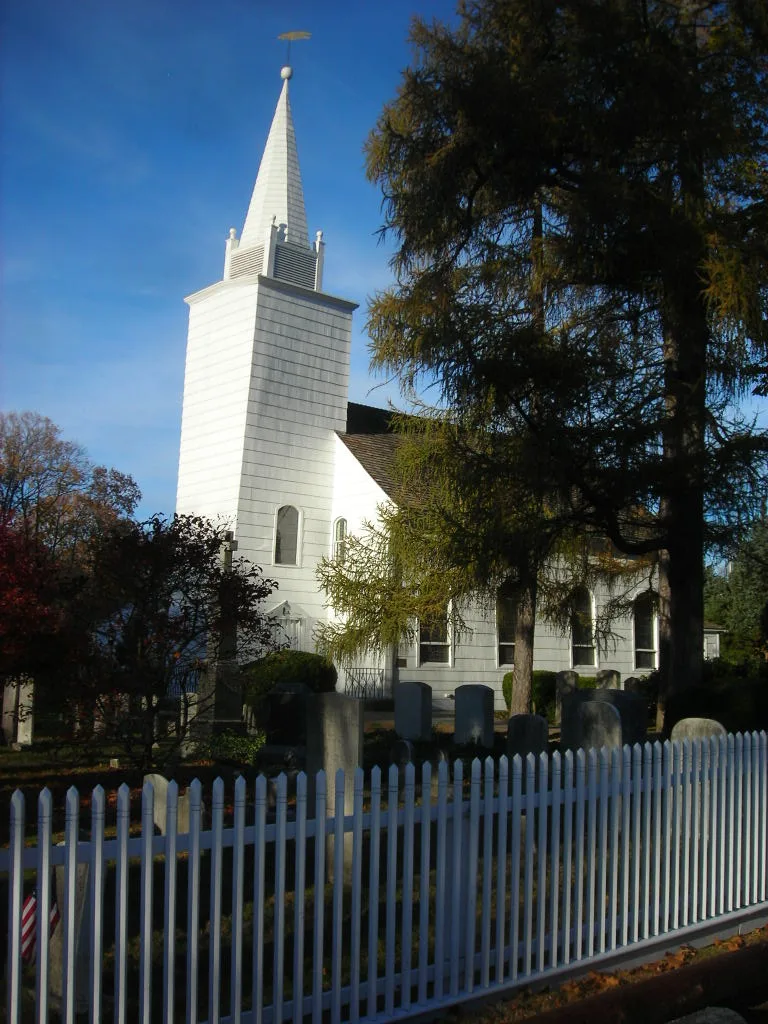
Caroline Church and its cemetery occupy a six-acre parcel beside the village green in Setauket, on Long Island's north shore. The church was built about 1729 by John Sears for an Anglican congregation that had been left without a place of worship. It is a three by four-bay building of heavy hewn timber framing, sheathed in wide wood shingles, with a central tower and narthex. A gallery was added in 1744, and a parish hall followed in 1905. In 1937 the parish hall was moved and joined to the church by an open passage, and the interior was restored in a Colonial Revival manner. The cemetery, established in 1734, holds nearly 900 markers showing changing funerary motifs from winged effigies to Gothic Revival designs. The property was recognized as a rare surviving example of settlement-era building tradition and as the oldest Episcopal church building on Long Island. Its significance period runs from 1729 to 1940.
Machine-generated summary. This summary was generated by a language model from the official nomination document and has not been reviewed line by line by an editor. It may contain errors. Check the source document before relying on any detail. Source: nomination document (PDF) · catalog entry. Generated October 2026 (model claude-sonnet-5-5, prompt v1.0-2026-10-29).
| Period of significance | 1729 - 1940 |
|---|---|
| Styles | No style |
| Areas of significance | Architecture |
| Acreage | 6 |
| Boundary source | not published |
| Full listing page | Caroline Church and Cemetery (property record) |
What listing means for this property
This is a historic district. Buildings within its boundary are either contributing (they add to the district's significance) or non-contributing. Owners of contributing income-producing buildings can claim the 20% federal rehabilitation tax credit; homeowners should look at state credits. National Register districts impose no design review by themselves; a local historic district ordinance, if one exists, does (the difference explained).
General information, not legal or tax advice. Rules change; confirm with your State Historic Preservation Office or a qualified adviser.