Broadway-Livingston Avenue Historic District

Why it's listed
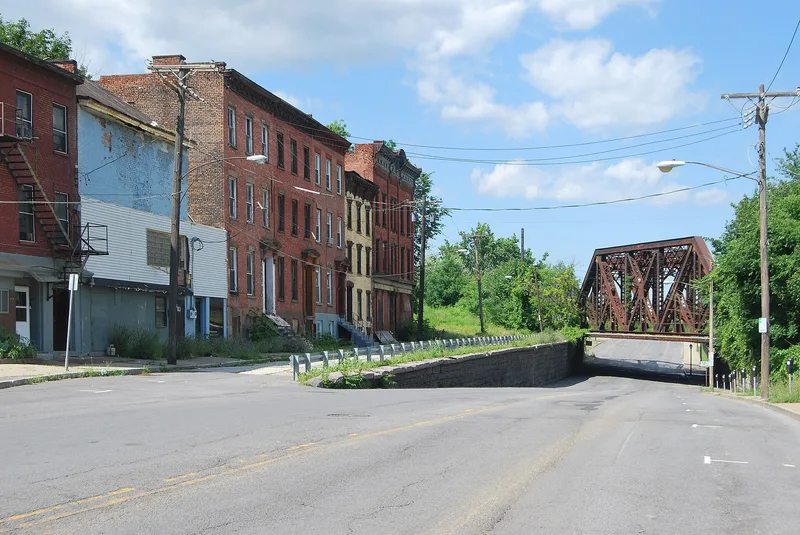
Broadway-Livingston Avenue is a small cluster of 21 historic features in northeast Albany, just north of the downtown business district. It holds two- to four-story brick rowhouses and commercial buildings built between 1829 and 1876, split almost evenly between Greek Revival and Italianate styles. Several storefronts keep original cast-iron fronts, notably 810-812 Broadway, built in 1872. At the north end, a 1900 riveted Warren truss railroad bridge on a cut-stone viaduct carries New York Central tracks over Broadway at Colonie Street. The area grew in the mid-1800s because of its closeness to the Erie Canal terminus, the river ferries and the rail lines. Merchants, manufacturers and laborers lived and worked here, and small shops served the neighborhood. Urban renewal demolition since the 1960s cleared the surrounding blocks, leaving this group as the only intact stretch of nineteenth-century architecture on north Broadway. The buildings are generally deteriorated but still show their original character.
Machine-generated summary. This summary was generated by a language model from the official nomination document and has not been reviewed line by line by an editor. It may contain errors. Check the source document before relying on any detail. Source: nomination document (PDF) · catalog entry. Generated October 2026 (model claude-sonnet-5-5, prompt v1.0-2026-10-29).
| Period of significance | 1829-1900 |
|---|---|
| Styles | Greek Revival and Italianate |
| Areas of significance | Commerce, Transportation, Architecture |
| Acreage | 3.5 |
| Boundary source | NPS cultural-resource GIS polygon |
| Full listing page | Broadway-Livingston Avenue Historic District (property record) |
What listing means for this property
This is a historic district. Buildings within its boundary are either contributing (they add to the district's significance) or non-contributing. Owners of contributing income-producing buildings can claim the 20% federal rehabilitation tax credit; homeowners should look at state credits. National Register districts impose no design review by themselves; a local historic district ordinance, if one exists, does (the difference explained).
General information, not legal or tax advice. Rules change; confirm with your State Historic Preservation Office or a qualified adviser.