Broadway Historic District (Boundary Increase)

Why it's listed
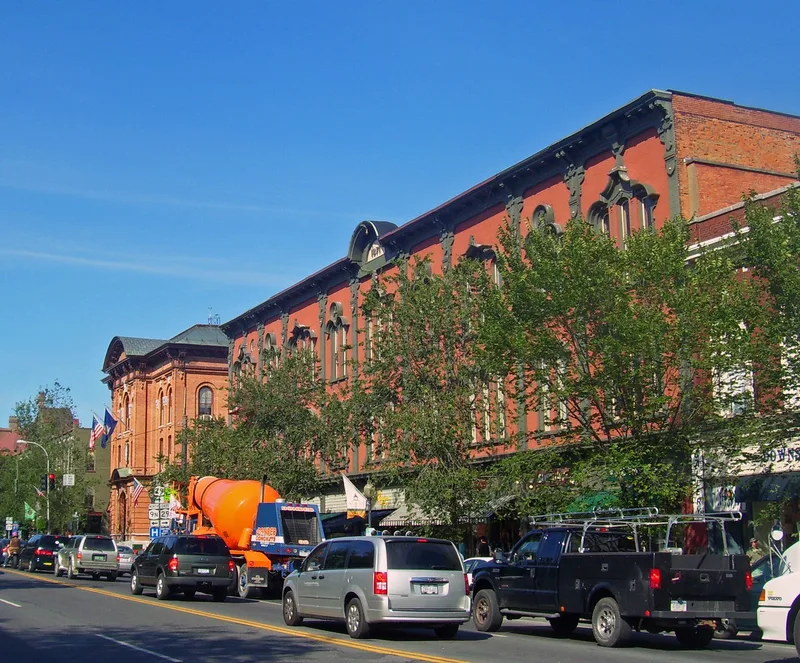
This amendment enlarges the Broadway Historic District in Saratoga Springs by 35 properties. Some are outbuildings tied to the grand summer cottages of North Broadway: carriage barns, a stable with a conical tower, a Tudor Revival superintendent's cottage, a Queen Anne guest house and an Italianate residence that once served a demolished mansion. The larger group is a set of brick and frame commercial buildings east of Broadway, along Lake Avenue and Caroline, Phila, Henry and Maple streets. Built mostly between 1865 and 1920, these two- to four-story buildings housed businesses that supported the hotel and resort trade during the city's years as the Queen of Spas. They are generally smaller and plainer than the Broadway storefronts, yet many keep original storefronts and details such as corbels and window moldings. Two modern one-story buildings are counted as non-contributing. The additions also correct earlier mapping errors that had separated main buildings from their dependencies.
Machine-generated summary. This summary was generated by a language model from the official nomination document and has not been reviewed line by line by an editor. It may contain errors. Check the source document before relying on any detail. Source: nomination document (PDF) · catalog entry. Generated October 2026 (model claude-sonnet-5-5, prompt v1.0-2026-10-29).
| Period of significance | 1865-1920 |
|---|---|
| Styles | Mixed, mainly Italianate commercial buildings, with Queen Anne, Romanesque Revival, Federal, Tudor Revival and Neoclassical examples |
| Areas of significance | Architecture |
| Acreage | 14 |
| Boundary source | NPS cultural-resource GIS polygon |
| Full listing page | Broadway Historic District (Boundary Increase) (property record) |
What listing means for this property
This is a historic district. Buildings within its boundary are either contributing (they add to the district's significance) or non-contributing. Owners of contributing income-producing buildings can claim the 20% federal rehabilitation tax credit; homeowners should look at state credits. National Register districts impose no design review by themselves; a local historic district ordinance, if one exists, does (the difference explained).
General information, not legal or tax advice. Rules change; confirm with your State Historic Preservation Office or a qualified adviser.