Boonville Historic District

Why it's listed
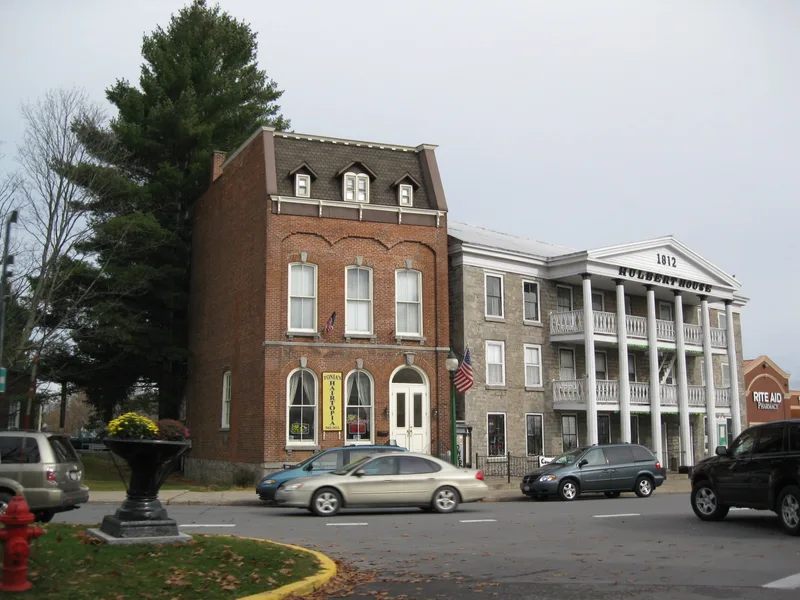
Boonville's historic district gathers the village's oldest commercial and residential streets around a triangular intersection that Holland Land Company planners laid out in the 1790s. The Hulbert House, a three-story Trenton limestone inn enlarged in 1839 from an 1812 building, anchors the eastern point. Nearby stands a brick Second Empire building of 1866, designed by Utica architect Azel J. Lathrop for Boonville's first locally organized bank and now used for municipal offices. A small park with an octagonal bandstand and a Civil War monument sits at the center. Along Schuyler, Post and West Streets are houses and churches from the early 1800s onward. They include Federal buildings such as the 1802 first village school, a Gothic Revival cottage influenced by A.J. Downing, Trinity Episcopal Church of 1857-58, and many Italianate residences with towers and cupolas. Standing seam metal roofs, consistent scale and quality materials unify the varied styles.
Machine-generated summary. This summary was generated by a language model from the official nomination document and has not been reviewed line by line by an editor. It may contain errors. Check the source document before relying on any detail. Source: nomination document (PDF) · catalog entry. Generated October 2026 (model claude-sonnet-5-5, prompt v1.0-2026-10-29).
| Styles | Mixed 19th-century styles: Federal, Greek Revival, Gothic Revival, Italianate, Second Empire, Queen Anne, Classical Revival |
|---|---|
| Areas of significance | Commerce, Historic - Non-Aboriginal, Architecture |
| Acreage | 26 |
| Boundary source | NPS cultural-resource GIS polygon |
| Full listing page | Boonville Historic District (property record) |
What listing means for this property
This is a historic district. Buildings within its boundary are either contributing (they add to the district's significance) or non-contributing. Owners of contributing income-producing buildings can claim the 20% federal rehabilitation tax credit; homeowners should look at state credits. National Register districts impose no design review by themselves; a local historic district ordinance, if one exists, does (the difference explained).
General information, not legal or tax advice. Rules change; confirm with your State Historic Preservation Office or a qualified adviser.