Binnewater Historic District

The National Park Service has not published a boundary polygon for this district; the map shows the listed properties inside it and the district's reference point.
Why it's listed
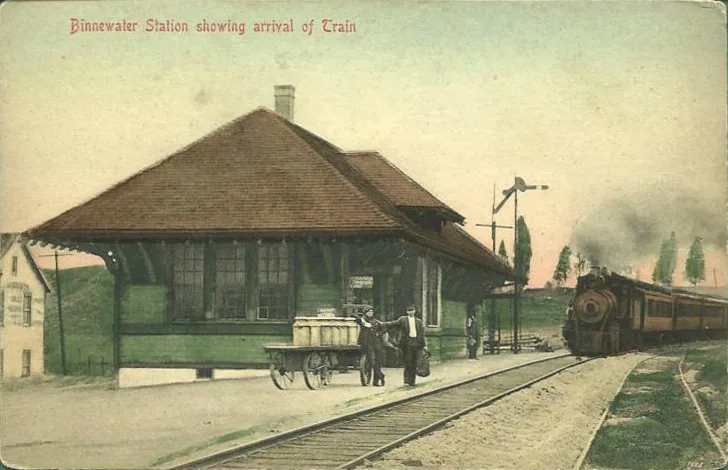
Binnewater is a small cluster of nine frame buildings about two miles north of Rosendale in Ulster County, New York. At its center is the former Wallkill Valley Railroad depot, built soon after the line's 1872 incorporation, with a deeply overhanging slate roof, large scrolled brackets and an intact wainscotted waiting room. Nearby are a privy, a general store and post office, a boarding house, a livery stable, a wagon shed, two barns and a farm cottage, most built around 1900. The district is recognized for its link to the Rosendale cement industry, which supplied material for projects such as the Brooklyn Bridge. The store began as a company store of a cement works, and the boarding house likely lodged its employees. Keator family land, farmed since the eighteenth century, supplied the depot lot and five of the buildings. The depot is the only one left of the region's stations. Despite deterioration, the group remains visually cohesive.
Machine-generated summary. This summary was generated by a language model from the official nomination document and has not been reviewed line by line by an editor. It may contain errors. Check the source document before relying on any detail. Source: nomination document (PDF) · catalog entry. Generated October 2026 (model claude-sonnet-5-5, prompt v1.0-2026-10-29).
| Period of significance | 1800-1899, 1900- (specific dates c.1872, c.1900) |
|---|---|
| Styles | Vernacular frame buildings; the depot has a low-pitch hipped slate roof with scrolled brackets |
| Areas of significance | Industry, Transportation, Architecture |
| Acreage | 6.7 |
| Boundary source | not published |
| Full listing page | Binnewater Historic District (property record) |
What listing means for this property
This is a historic district. Buildings within its boundary are either contributing (they add to the district's significance) or non-contributing. Owners of contributing income-producing buildings can claim the 20% federal rehabilitation tax credit; homeowners should look at state credits. National Register districts impose no design review by themselves; a local historic district ordinance, if one exists, does (the difference explained).
General information, not legal or tax advice. Rules change; confirm with your State Historic Preservation Office or a qualified adviser.