Big Duck Ranch

The National Park Service has not published a boundary polygon for this district; the map shows the listed properties inside it and the district's reference point.
Why it's listed
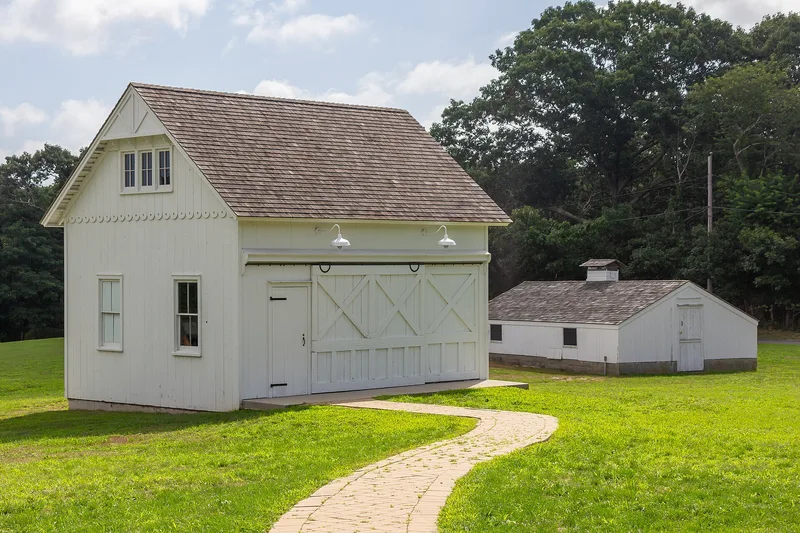
Big Duck Ranch is an 11.3-acre former duck farm in Flanders, Long Island, where Martin Maurer ran a duck-raising and retail business from 1936 until 1984. The district centers on the Big Duck, a concrete-over-wire-mesh building shaped like a duck and used as a roadside store. It was moved away in 1987-88 and returned to its original foundation in 2007. Three farm buildings survive with it: a long wooden brooder barn, the last of six, where ducklings were hatched; a one-and-a-half-story storage barn with late-Victorian detailing; and a small stucco retail store. A non-contributing wishing well dates from 1976. The property is important because these buildings show how a Long Island duck farm operated, from propagation to storage to sale. The surrounding meadow, woodland and tidal wetlands along Birch Creek add to the setting. The Town of Southampton plans to restore the buildings as a visitors' center.
Machine-generated summary. This summary was generated by a language model from the official nomination document and has not been reviewed line by line by an editor. It may contain errors. Check the source document before relying on any detail. Source: nomination document (PDF) · catalog entry. Generated October 2026 (model claude-sonnet-5-5, prompt v1.0-2026-10-29).
| Period of significance | 1936-1952 |
|---|---|
| Styles | no style |
| Areas of significance | Architecture, Agriculture |
| Acreage | 11.3 |
| Boundary source | not published |
| Full listing page | Big Duck Ranch (property record) |
What listing means for this property
This is a historic district. Buildings within its boundary are either contributing (they add to the district's significance) or non-contributing. Owners of contributing income-producing buildings can claim the 20% federal rehabilitation tax credit; homeowners should look at state credits. National Register districts impose no design review by themselves; a local historic district ordinance, if one exists, does (the difference explained).
General information, not legal or tax advice. Rules change; confirm with your State Historic Preservation Office or a qualified adviser.