Berkeley Square Historic District (Additional Documentation)

The National Park Service has not published a boundary polygon for this district; the map shows the listed properties inside it and the district's reference point.
Why it's listed
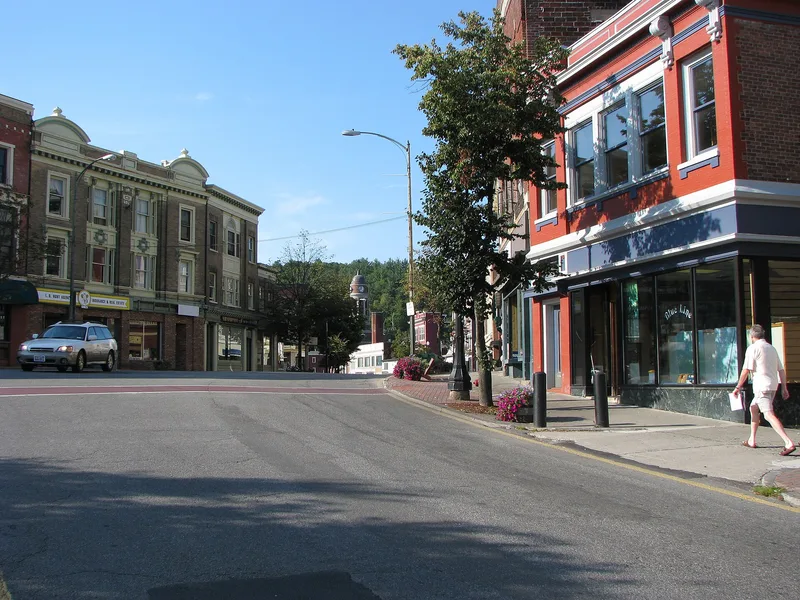
Saranac Lake's historic business center runs along Main Street and Broadway, where they meet at the "Y" long known as Berkeley Square. The district holds twenty-six buildings dating from 1867 to 1932, mostly three-story commercial blocks with attached or closely spaced fronts. Milo Miller's French Second Empire buildings, the oldest in the district, established business use of the street in the 1860s and 70s. After Dr. Edward Livingston Trudeau settled in the village in 1876 and later founded a sanitarium, the tuberculosis cure industry drove commercial growth. Several blocks, including the Donaldson, Haase, Fowler and Roberts buildings, were built with recessed galleries and balconies so patients could rent rooms and take the fresh air cure. At the southern end, the Beaux-Arts Harrietstown Town Hall, completed in 1928 after its predecessor burned, has a domed clock tower, limestone trim and a marble staircase. Together the buildings form an urban streetscape that contrasts with the wooded Adirondack setting.
Machine-generated summary. This summary was generated by a language model from the official nomination document and has not been reviewed line by line by an editor. It may contain errors. Check the source document before relying on any detail. Source: nomination document (PDF) · catalog entry. Generated October 2026 (model claude-sonnet-5-5, prompt v1.0-2026-10-29).
| Styles | French Second Empire, Colonial Revival, Italian Renaissance Revival, Art Deco, Beaux-Arts Classicism and other late 19th and early 20th century revival styles |
|---|---|
| Areas of significance | Health/Medicine, Architecture, Commerce |
| Acreage | 9.53 |
| Boundary source | not published |
| Full listing page | Berkeley Square Historic District (Additional Documentation) (property record) |
What listing means for this property
This is a historic district. Buildings within its boundary are either contributing (they add to the district's significance) or non-contributing. Owners of contributing income-producing buildings can claim the 20% federal rehabilitation tax credit; homeowners should look at state credits. National Register districts impose no design review by themselves; a local historic district ordinance, if one exists, does (the difference explained).
General information, not legal or tax advice. Rules change; confirm with your State Historic Preservation Office or a qualified adviser.