Arbor Hill Historic District-Ten Broeck Triangle

Why it's listed
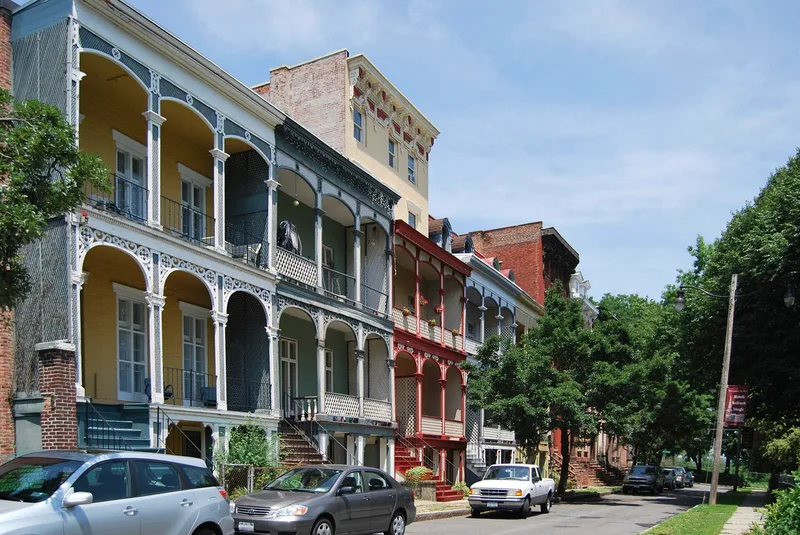
Ten Broeck Historic District is a compact residential neighborhood in Albany's Arbor Hill, just north of downtown. Its ninety-seven townhouses are arranged around two small parks and the large Gothic-style St. Joseph's Church, designed by Patrick Keeley and built between 1855 and 1860 of Schenectady bluestone. Most of the district was built between 1845 and 1875. The earliest houses are frame buildings from the 1840s. Later brick houses, often trimmed or faced with brownstone, are generally Italianate, two to three stories high, with bracketed cornices and several Mansard roofs. Romanesque row houses and apartment buildings from the 1890s to 1914 fill St. Joseph's Terrace. Other notable features include the two-story lattice porches at 2-6 Hall Place, dating from 1859, and the Federal-style Ten Broeck Mansion of 1797-98 in the northwest corner. The nomination values the district because its nineteenth-century streetscape remains virtually intact, with no modern intrusions, and because it contains several buildings of exceptional architectural interest.
Machine-generated summary. This summary was generated by a language model from the official nomination document and has not been reviewed line by line by an editor. It may contain errors. Check the source document before relying on any detail. Source: nomination document (PDF) · catalog entry. Generated October 2026 (model claude-sonnet-5-5, prompt v1.0-2026-10-29).
| Styles | Predominantly Italianate, with Greek Revival, Romanesque, Gothic and Federal buildings |
|---|---|
| Areas of significance | Architecture |
| Acreage | 13 |
| Boundary source | NPS cultural-resource GIS polygon |
| Full listing page | Arbor Hill Historic District-Ten Broeck Triangle (property record) |
What listing means for this property
This is a historic district. Buildings within its boundary are either contributing (they add to the district's significance) or non-contributing. Owners of contributing income-producing buildings can claim the 20% federal rehabilitation tax credit; homeowners should look at state credits. National Register districts impose no design review by themselves; a local historic district ordinance, if one exists, does (the difference explained).
General information, not legal or tax advice. Rules change; confirm with your State Historic Preservation Office or a qualified adviser.