Woodford Street Historic District

Why it's listed
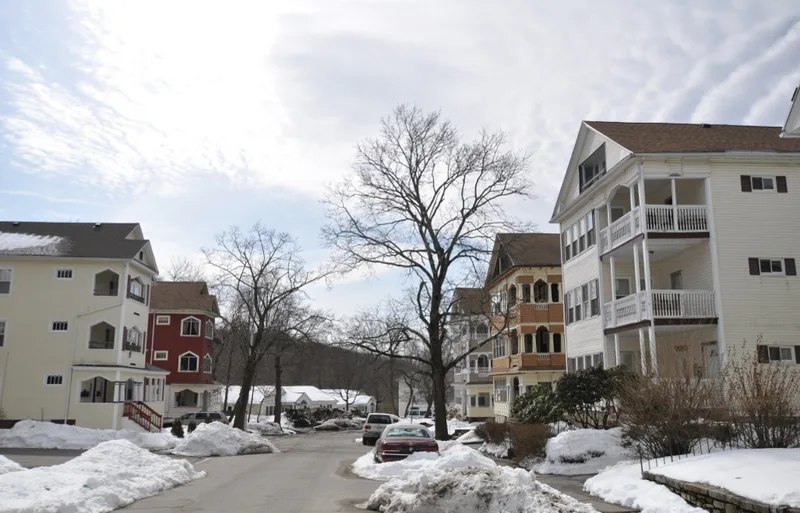
Five three-decker houses and their five rear garages make up this small district at the southern end of Woodford Street in Worcester. All were built around 1926 as part of an automobile-oriented suburb east of the Vernon Hill Playground. Each house has a gable roof with a pedimented facade, a three-tier porch, wide bracketed cornices, and clapboard on the first story with shingles above. Porch openings vary between semicircular, peaked and basket-handle shapes, and the garages are cinderblock. The district is notable for how well this late group of three-deckers has been preserved. It also records a pattern of settlement: the first owners and tenants included grocers, merchants, a brick company president and craftsmen, many of them Jewish families who had left the older Grafton Hill neighborhood along Providence Street. The area was judged significant locally for its history and its architecture, and it retains its original character.
Machine-generated summary. This summary was generated by a language model from the official nomination document and has not been reviewed line by line by an editor. It may contain errors. Check the source document before relying on any detail. Source: nomination document (PDF) · catalog entry. Generated October 2026 (model claude-sonnet-5-5, prompt v1.0-2026-10-29).
| Styles | Eclectic Colonial Revival/Craftsman (three-deckers) |
|---|---|
| Areas of significance | Community Planning and Development, European, Architecture, Social History |
| Acreage | 0.7 |
| Boundary source | NPS cultural-resource GIS polygon |
| Full listing page | Woodford Street Historic District (property record) |
What listing means for this property
This is a historic district. Buildings within its boundary are either contributing (they add to the district's significance) or non-contributing. Owners of contributing income-producing buildings can claim the 20% federal rehabilitation tax credit; homeowners should look at state credits. National Register districts impose no design review by themselves; a local historic district ordinance, if one exists, does (the difference explained).
General information, not legal or tax advice. Rules change; confirm with your State Historic Preservation Office or a qualified adviser.