Winthrop Shore Dr., Metropolitan Park System of Greater Boston

The National Park Service has not published a boundary polygon for this district; the map shows the listed properties inside it and the district's reference point.
Why it's listed
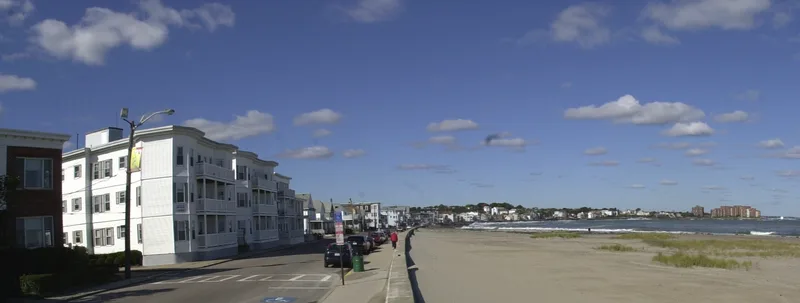
Winthrop Shore Drive is a short ocean parkway in Winthrop, Massachusetts, following the shore of Broad Sound above Winthrop Beach. Two 14-foot asphalt lanes run between a concrete seawall on the ocean side and a line of wood-frame homes on the inland side. Parallel parking, granite curbs, concrete sidewalks and an oval landscaped miter at Beacon Street complete the corridor. A granite monument placed in 1927 by the Daughters of the American Revolution marks the capture of the British ship Hope in 1776. The road was built in 1899 after a storm washed out the beach in 1898, when the Legislature funded a seawall, sidewalks and a promenade along the former Crest Avenue. It grew from Charles Eliot's 1897 argument that the shoreline should be secured for public use before private owners shut people out. Its granite seawall dates to 1905 and later extensions. It is listed for its role in park planning, conservation, engineering and recreation, and for its design by the Olmsted firms.
Machine-generated summary. This summary was generated by a language model from the official nomination document and has not been reviewed line by line by an editor. It may contain errors. Check the source document before relying on any detail. Source: nomination document (PDF) · catalog entry. Generated October 2026 (model claude-sonnet-5-5, prompt v1.0-2026-10-29).
| Period of significance | 1899-1956 |
|---|---|
| Areas of significance | Community Planning and Development, Conservation, Engineering, Entertainment/Recreation, Landscape Architecture, Transportation |
| Acreage | 6 |
| Boundary source | not published |
| Full listing page | Winthrop Shore Dr., Metropolitan Park System of Greater Boston (property record) |
What listing means for this property
This is a historic district. Buildings within its boundary are either contributing (they add to the district's significance) or non-contributing. Owners of contributing income-producing buildings can claim the 20% federal rehabilitation tax credit; homeowners should look at state credits. National Register districts impose no design review by themselves; a local historic district ordinance, if one exists, does (the difference explained).
General information, not legal or tax advice. Rules change; confirm with your State Historic Preservation Office or a qualified adviser.