Wilson, Capt. John, House and Bates Ship Chandlery

The National Park Service has not published a boundary polygon for this district; the map shows the listed properties inside it and the district's reference point.
Why it's listed
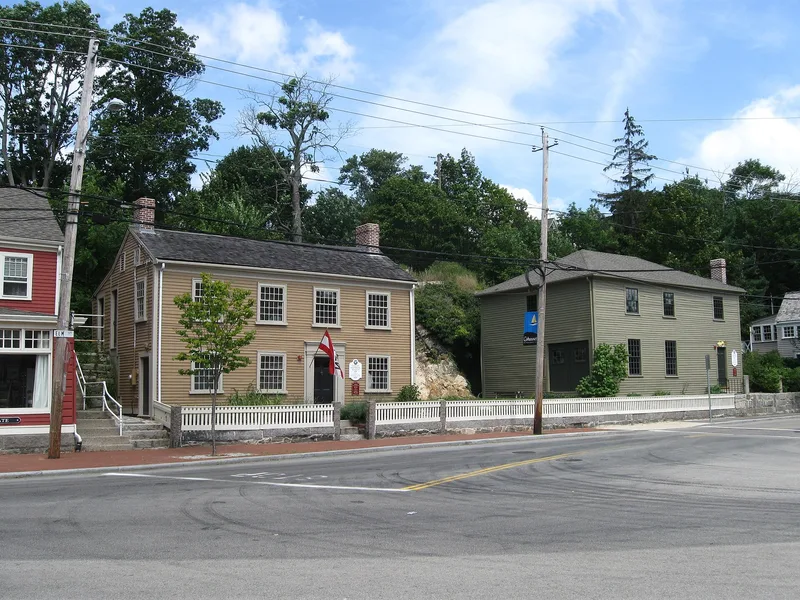
Two historic buildings share a lot at 4 Elm Street in the center of Cohasset, Massachusetts, and both now serve as museums. The Captain John Wilson House, built in 1810, is a 2½-story Federal-style wood-frame house with twin interior chimneys and a rear second-story addition of about 1830. Its first floor was reportedly used for commerce while the family lived upstairs. Wilson was a ship master who sailed fishing and trading schooners and made voyages to Spain, the Caribbean and France. Next door, the Bates Ship Chandlery dates most likely to the mid-18th century and was built by Samuel Bates as a supply store and office for his wharf and schooner fleet. It was moved to Elm Street in 1957 and restored. Its exposed post-and-beam frame and king-post roof trusses survive. It is described as the only known extant 18th-century structure built expressly as a chandlery in Massachusetts. The Wilson House was donated to the Cohasset Historical Society in 1936.
Machine-generated summary. This summary was generated by a language model from the official nomination document and has not been reviewed line by line by an editor. It may contain errors. Check the source document before relying on any detail. Source: nomination document (PDF) · catalog entry. Generated October 2026 (model claude-sonnet-5-5, prompt v1.0-2026-10-29).
| Styles | Early Republic: Federal; Colonial/Georgian |
|---|---|
| Areas of significance | Architecture, Community Planning and Development, Commerce, Maritime History |
| Acreage | 0.9 |
| Boundary source | not published |
| Full listing page | Wilson, Capt. John, House and Bates Ship Chandlery (property record) |
What listing means for this property
This is a historic district. Buildings within its boundary are either contributing (they add to the district's significance) or non-contributing. Owners of contributing income-producing buildings can claim the 20% federal rehabilitation tax credit; homeowners should look at state credits. National Register districts impose no design review by themselves; a local historic district ordinance, if one exists, does (the difference explained).
General information, not legal or tax advice. Rules change; confirm with your State Historic Preservation Office or a qualified adviser.