Webster Municipal Buildings Historic District

Why it's listed
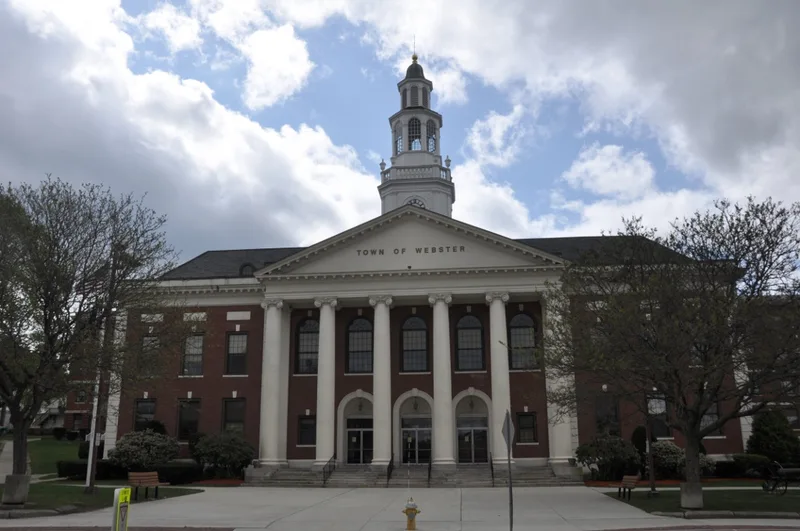
Webster's municipal district occupies a green block at the east end of the downtown commercial area, between Main Street shops and neighbouring houses. It holds Bartlett High School, built 1903-5 and enlarged around 1927-28, and the brick Town Hall of the same years, joined by a shared 1,638-seat auditorium. The Chester C. Corbin Public Library, built in 1920 with a bequest from Mrs. Corbin, adds Classical Revival details to Craftsman-style massing. A 1907 granite and bronze Soldiers' Monument, with statues by sculptor Finn Haakon Frolich, honors Civil War service. Two Civil War-era howitzers, a relocated granite horse trough and a later Veterans' Court of Honor complete the grounds. Together the buildings and monuments form a unified civic center that contrasts with the varied commercial architecture nearby. The grouping reflects the town's investment in education, government, learning and remembrance between 1903 and 1961.
Machine-generated summary. This summary was generated by a language model from the official nomination document and has not been reviewed line by line by an editor. It may contain errors. Check the source document before relying on any detail. Source: nomination document (PDF) · catalog entry. Generated October 2026 (model claude-sonnet-5-5, prompt v1.0-2026-10-29).
| Period of significance | 1903-1961 |
|---|---|
| Styles | Late 19th and 20th-Century Revivals/Classical Revival |
| Areas of significance | Architecture, Community Planning and Development |
| Acreage | 3.4 |
| Boundary source | NPS cultural-resource GIS polygon |
| Full listing page | Webster Municipal Buildings Historic District (property record) |
What listing means for this property
This is a historic district. Buildings within its boundary are either contributing (they add to the district's significance) or non-contributing. Owners of contributing income-producing buildings can claim the 20% federal rehabilitation tax credit; homeowners should look at state credits. National Register districts impose no design review by themselves; a local historic district ordinance, if one exists, does (the difference explained).
General information, not legal or tax advice. Rules change; confirm with your State Historic Preservation Office or a qualified adviser.