Washington Street Theatre District

The National Park Service has not published a boundary polygon for this district; the map shows the listed properties inside it and the district's reference point.
Why it's listed
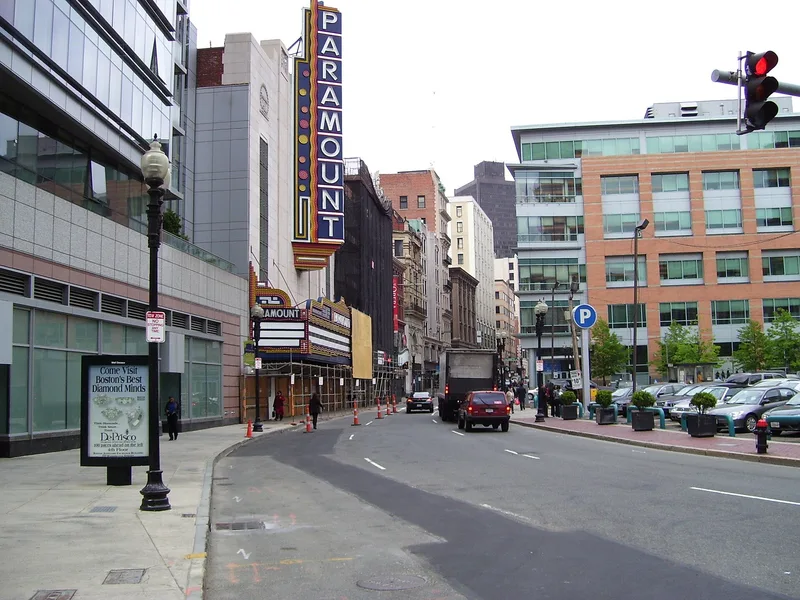
Seven buildings along the west side of Washington Street in downtown Boston, erected between 1870 and 1935, form a block tied to the city's theater history. They range from four to seven stories and mix brick, granite, limestone and tile, with Italianate, Gothic, Beaux Arts and Art Deco designs. Among them are Arthur Bowditch's 1932 Paramount Theater, with its large neon sign, and Thomas Lamb's 1928 Savoy Theater, the only surviving Lamb theater in the city. The Adams House Annex was where B.F. Keith introduced continuous vaudeville and moving pictures to Boston, and the Savoy site had held the city's earliest theaters, beginning with Charles Bulfinch's Boston Theatre of 1794. The Mayflower/Dobson Building was converted to a theater in 1913 by Clarence Blackall with acoustician Wallace Sabine. The White Building and Bigelow-Kennard Building add commercial architecture of similar scale and period. Together they illustrate musical comedy, opera, vaudeville and film presented on a single block.
Machine-generated summary. This summary was generated by a language model from the official nomination document and has not been reviewed line by line by an editor. It may contain errors. Check the source document before relying on any detail. Source: nomination document (PDF) · catalog entry. Generated October 2026 (model claude-sonnet-5-5, prompt v1.0-2026-10-29).
| Styles | Italianate, High Victorian Gothic, Beaux Arts and Modernistic |
|---|---|
| Areas of significance | Architecture, Performing Arts |
| Acreage | 1.7 |
| Boundary source | not published |
| Full listing page | Washington Street Theatre District (property record) |
What listing means for this property
This is a historic district. Buildings within its boundary are either contributing (they add to the district's significance) or non-contributing. Owners of contributing income-producing buildings can claim the 20% federal rehabilitation tax credit; homeowners should look at state credits. National Register districts impose no design review by themselves; a local historic district ordinance, if one exists, does (the difference explained).
General information, not legal or tax advice. Rules change; confirm with your State Historic Preservation Office or a qualified adviser.