Washburn and Moen North Works District

The National Park Service has not published a boundary polygon for this district; the map shows the listed properties inside it and the district's reference point.
Why it's listed
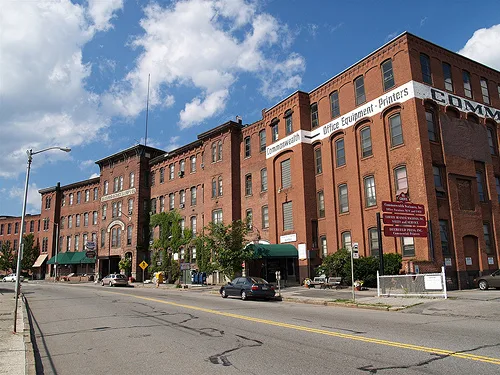
The North Works, also called the Grove Street Works, is a group of brick and stone industrial buildings in Worcester, Massachusetts, built between 1863 and the early 1930s by the Washburn & Moen Manufacturing Company and its successor. The complex includes the Cotton Mill, the Long Mill, a machine shop, annealing houses, rolling mills and a Main Building that once held the company offices. Its Grove Street front runs over 500 feet and was dominated by a central tower, while the Prescott Street side forms a continuous band of plainer brick factories. The firm traces its roots to Ichabod Washburn's wire-drawing work in the 1830s and grew into the city's largest industry. Major construction took place between 1863 and 1870, and the nation's first continuous wire-rod rolling mill, imported from England, was installed here in 1869. Steel and wire making at the site ended in 1943, but most of the buildings survive in good condition and remain in industrial and commercial use.
Machine-generated summary. This summary was generated by a language model from the official nomination document and has not been reviewed line by line by an editor. It may contain errors. Check the source document before relying on any detail. Source: nomination document (PDF) · catalog entry. Generated October 2026 (model claude-sonnet-5-5, prompt v1.0-2026-10-29).
| Period of significance | 1863-1930 |
|---|---|
| Styles | Mixed Victorian; Second Empire detailing on the Main Building |
| Areas of significance | Industry, Exploration/Settlement, Invention |
| Acreage | 7 |
| Boundary source | not published |
| Full listing page | Washburn and Moen North Works District (property record) |
What listing means for this property
This is a historic district. Buildings within its boundary are either contributing (they add to the district's significance) or non-contributing. Owners of contributing income-producing buildings can claim the 20% federal rehabilitation tax credit; homeowners should look at state credits. National Register districts impose no design review by themselves; a local historic district ordinance, if one exists, does (the difference explained).
General information, not legal or tax advice. Rules change; confirm with your State Historic Preservation Office or a qualified adviser.