Upper Worthington Historic District (Boundary Increase)

Why it's listed
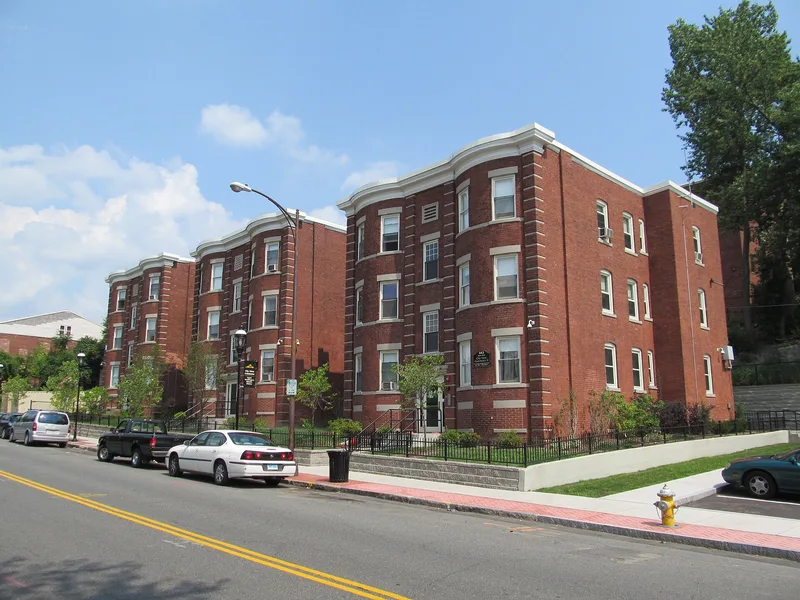
Five properties along the south side of Taylor Street in Springfield, Massachusetts, were added to an existing apartment district. Four contribute: three brick apartment blocks at 443, 449 and 453 Taylor Street, built in 1912, and a two-story brick garage at 469-473 Taylor Street, built in 1917. The fifth, a one-story warehouse with a 1970s facade, does not contribute. The apartment blocks are three stories over a raised basement, with Georgian Revival details such as banded pilasters, concrete lintels and projecting cornices. They were the first completed buildings in the redevelopment of the former Kibbe Estate, and they were built by the developers Gagnier & Angers. The garage first housed an auto repair shop and a car dealer, reflecting the city's automobile boom. It is among the earliest and best preserved of Springfield's two-story garages. The buildings are currently vacant and deteriorated, with rehabilitation planned. The area is significant locally for architecture and for early 20th century residential development.
Machine-generated summary. This summary was generated by a language model from the official nomination document and has not been reviewed line by line by an editor. It may contain errors. Check the source document before relying on any detail. Source: nomination document (PDF) · catalog entry. Generated October 2026 (model claude-sonnet-5-5, prompt v1.0-2026-10-29).
| Period of significance | 1912-1929 |
|---|---|
| Styles | Georgian Revival |
| Areas of significance | Community Planning and Development, Economics, Architecture |
| Acreage | 0.8 |
| Boundary source | NPS cultural-resource GIS polygon |
| Full listing page | Upper Worthington Historic District (Boundary Increase) (property record) |
What listing means for this property
This is a historic district. Buildings within its boundary are either contributing (they add to the district's significance) or non-contributing. Owners of contributing income-producing buildings can claim the 20% federal rehabilitation tax credit; homeowners should look at state credits. National Register districts impose no design review by themselves; a local historic district ordinance, if one exists, does (the difference explained).
Noted as vacant in the nomination. Nomination documents can be decades old; current status may differ. If you are considering buying an empty listed property, read the due-diligence checklist.
General information, not legal or tax advice. Rules change; confirm with your State Historic Preservation Office or a qualified adviser.