Union Street Historic District

Why it's listed
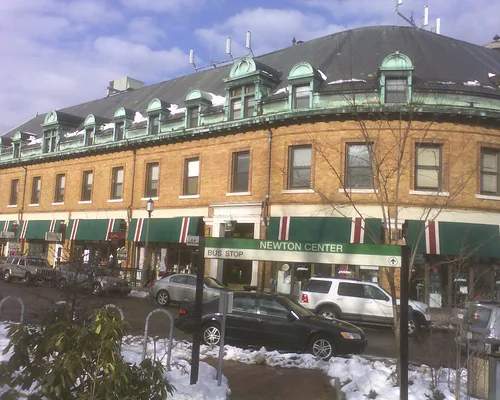
Union Street Historic District is a compact commercial area in Newton Centre, Massachusetts, organized around the commuter railroad station. Before improved rail service, Newton Centre had little development, with fewer than ten buildings near the common. After the Boston & Albany Railroad upgraded the line, the station was completed in 1890 by Shepley, Rutan & Coolidge following H.H. Richardson's death. It has granite and brownstone walls and a large overhanging slate roof. New commercial buildings followed. Mellen Bray, an inventor and investor, built Bray's Block in 1893, a buff brick Classical Revival building that once held an assembly hall, a bowling alley, offices and shops. The Union Building of 1896 is Georgian Revival. Bray also built Bradford Court in 1913, the village's first apartment building. The district is considered the city's best surviving cluster of nineteenth-century commercial buildings and shows how a small business center developed around a suburban depot.
Machine-generated summary. This summary was generated by a language model from the official nomination document and has not been reviewed line by line by an editor. It may contain errors. Check the source document before relying on any detail. Source: nomination document (PDF) · catalog entry. Generated October 2026 (model claude-sonnet-5-5, prompt v1.0-2026-10-29).
| Styles | Richardsonian (station), Classical Revival (Bray's Block), Georgian Revival (Union Building), Jacobean Revival (Bradford Court) |
|---|---|
| Areas of significance | Commerce, Architecture |
| Acreage | 1.8 |
| Boundary source | NPS cultural-resource GIS polygon |
| Full listing page | Union Street Historic District (property record) |
What listing means for this property
This is a historic district. Buildings within its boundary are either contributing (they add to the district's significance) or non-contributing. Owners of contributing income-producing buildings can claim the 20% federal rehabilitation tax credit; homeowners should look at state credits. National Register districts impose no design review by themselves; a local historic district ordinance, if one exists, does (the difference explained).
General information, not legal or tax advice. Rules change; confirm with your State Historic Preservation Office or a qualified adviser.