Temple Place Historic District

Why it's listed
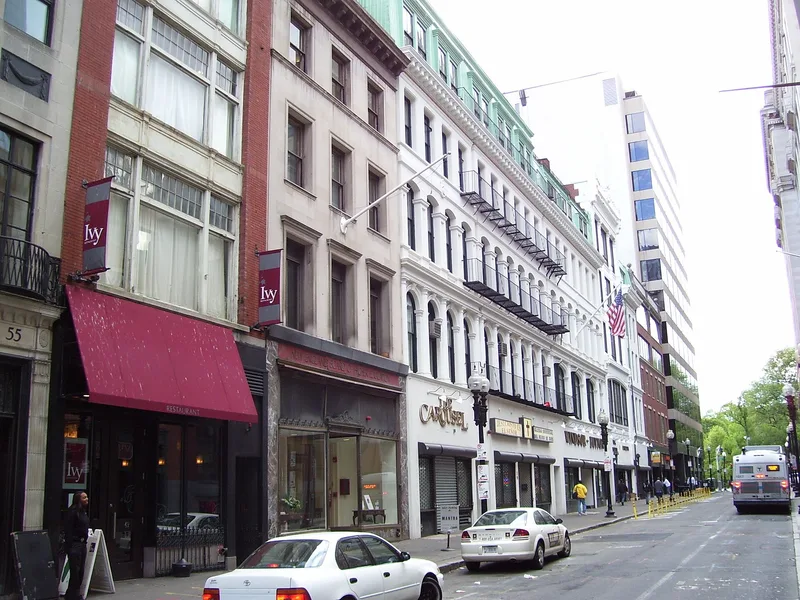
Temple Place is a one-block street in downtown Boston, just southeast of Boston Common, lined with fourteen small-scale commercial buildings of three to six stories. Greek Revival row houses from the 1830s recall its early years as one of the city's most prestigious residential addresses, home to the merchant Thomas Handasyd Perkins. After the 1860s the street turned to commerce and became known for shops serving women, and Mansard-style granite buildings from 1865 to 1870 reflect that shift. Three of them are rare surviving pre-fire works by architect Nathaniel J. Bradlee. Early twentieth-century buildings add Beaux Arts, Italian Renaissance, Federal Revival and pier-and-spandrel designs. Because the street escaped the Great Fire of 1872 and has seen little new development in the last fifty years, it keeps the scale of a mid-nineteenth-century commercial street. It was recognized for its architecture and its role in the growth of Boston's central business district.
Machine-generated summary. This summary was generated by a language model from the official nomination document and has not been reviewed line by line by an editor. It may contain errors. Check the source document before relying on any detail. Source: nomination document (PDF) · catalog entry. Generated October 2026 (model claude-sonnet-5-5, prompt v1.0-2026-10-29).
| Period of significance | 1830-1938 |
|---|---|
| Styles | Mid-19th century/Greek Revival; Late Victorian/Second Empire; Late Victorian/Renaissance Revival; Late-19th and Early-20th century American Movements |
| Areas of significance | Community Planning and Development, Commerce, Architecture |
| Acreage | 1 |
| Boundary source | NPS cultural-resource GIS polygon |
| Full listing page | Temple Place Historic District (property record) |
What listing means for this property
This is a historic district. Buildings within its boundary are either contributing (they add to the district's significance) or non-contributing. Owners of contributing income-producing buildings can claim the 20% federal rehabilitation tax credit; homeowners should look at state credits. National Register districts impose no design review by themselves; a local historic district ordinance, if one exists, does (the difference explained).
General information, not legal or tax advice. Rules change; confirm with your State Historic Preservation Office or a qualified adviser.