St. Luke's and St. Margaret's Church

The National Park Service has not published a boundary polygon for this district; the map shows the listed properties inside it and the district's reference point.
Why it's listed
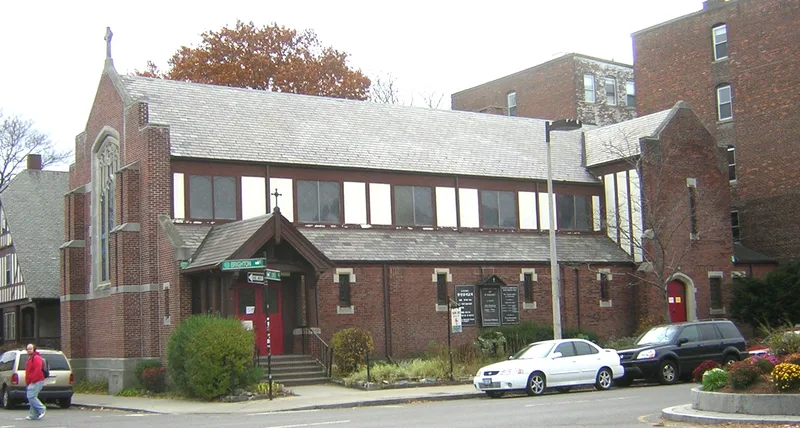
Three Episcopal parish buildings stand together on a small corner lot at Brighton Avenue and St. Luke's Road in Allston, Boston. The half-timbered Chapel and Rectory were built in 1895 to designs by Francis Allen, and Berry and Davidson added the brick and half-timbered Tudor Gothic church in 1913. A two-story hyphen links the old chapel to the new church, and the three buildings form a courtyard open to St. Luke's Road. The church interior is plain, which lets its stained glass and chancel carving stand out. Windows include a Tiffany window of St. John, moved from the chapel in 1913, and many pieces by Charles Connick and the Whittemore Studios. The parish formed in 1892 and was noted for its young membership. It grew up with the surrounding Packard's Corner neighborhood, an early center of automobile dealerships and apartment buildings. The complex is recognized for its architecture, its glass and its role in neighborhood life.
Machine-generated summary. This summary was generated by a language model from the official nomination document and has not been reviewed line by line by an editor. It may contain errors. Check the source document before relying on any detail. Source: nomination document (PDF) · catalog entry. Generated October 2026 (model claude-sonnet-5-5, prompt v1.0-2026-10-29).
| Styles | Tudor Revival |
|---|---|
| Areas of significance | Social History, Religion, Architecture |
| Acreage | 0.9 |
| Boundary source | not published |
| Full listing page | St. Luke's and St. Margaret's Church (property record) |
What listing means for this property
This is a historic district. Buildings within its boundary are either contributing (they add to the district's significance) or non-contributing. Owners of contributing income-producing buildings can claim the 20% federal rehabilitation tax credit; homeowners should look at state credits. National Register districts impose no design review by themselves; a local historic district ordinance, if one exists, does (the difference explained).
General information, not legal or tax advice. Rules change; confirm with your State Historic Preservation Office or a qualified adviser.