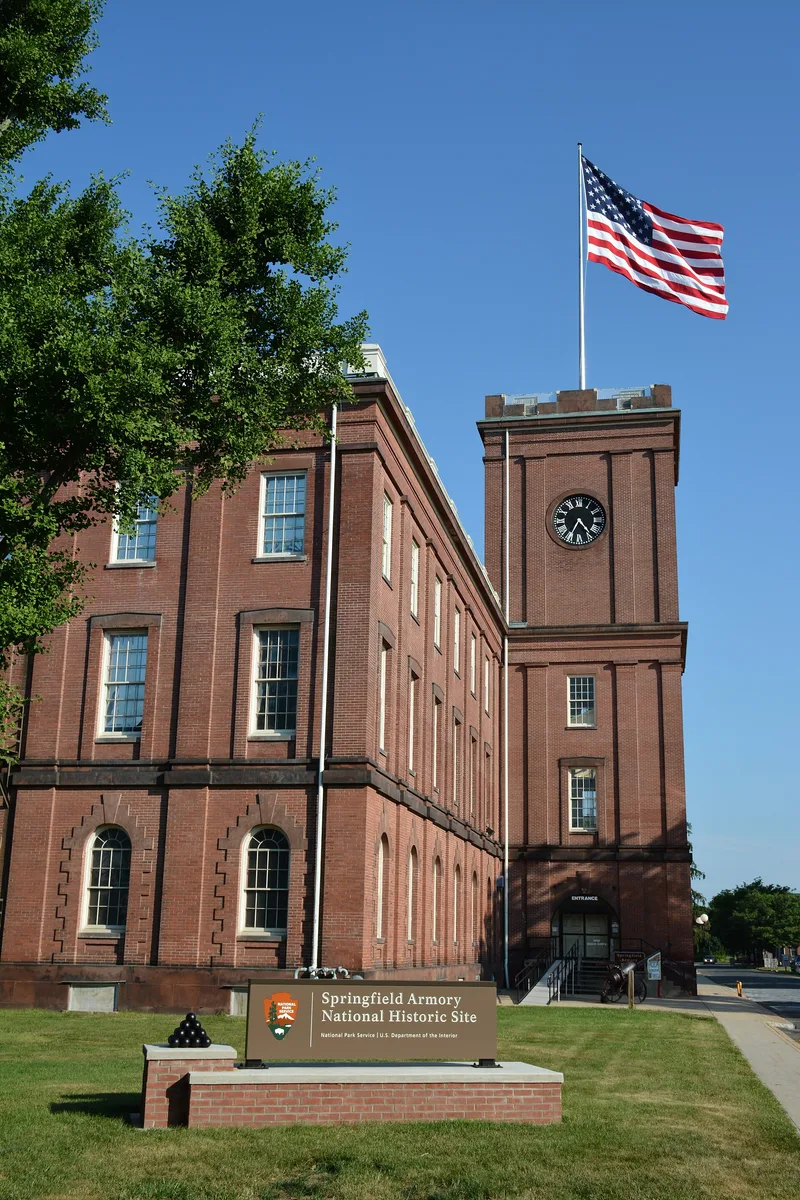
Springfield Armory National Historic Site

Why it's listed
Armory Square is a 54-acre hilltop district in Springfield, Massachusetts, once the administrative center of the Springfield Armory. Nearly thirty brick buildings with slate roofs, white trim and a consistent scale surround an 8.75-acre parade ground. They include the Greek Revival Commanding Officer's Quarters of 1845-46, the West Arsenal of 1807-08 (the oldest surviving building), the Main Arsenal with its clock tower, and a 764-foot cavalry stable and barracks from 1863. Congress established the Armory as a Federal arsenal in 1794, though it had already served as a Revolutionary War supply depot and was the target of Shays' Rebellion in 1787. Its workers helped develop interchangeable parts, and it was long the nation's principal small arms manufacturer. The Armory closed as a military post in 1967-68. Today a technical community college occupies much of the Square, and a museum in the Main Arsenal houses a major small arms collection. Two newer college buildings are considered intrusions.
Machine-generated summary. This summary was generated by a language model from the official nomination document and has not been reviewed line by line by an editor. It may contain errors. Check the source document before relying on any detail. Source: nomination document (PDF) · catalog entry. Generated October 2026 (model claude-sonnet-5-5, prompt v1.0-2026-10-29).
| Period of significance | 1778-1968 |
|---|---|
| Styles | Greek Revival, Second Empire and other restrained, functional military styles in brick with slate roofs |
| Areas of significance | Military, Politics/Government |
| Acreage | 54 |
| Boundary source | NPS cultural-resource GIS polygon |
| Full listing page | Springfield Armory National Historic Site (property record) |
What listing means for this property
This is a historic district. Buildings within its boundary are either contributing (they add to the district's significance) or non-contributing. Owners of contributing income-producing buildings can claim the 20% federal rehabilitation tax credit; homeowners should look at state credits. National Register districts impose no design review by themselves; a local historic district ordinance, if one exists, does (the difference explained).
General information, not legal or tax advice. Rules change; confirm with your State Historic Preservation Office or a qualified adviser.