Sharon Historic District

The National Park Service has not published a boundary polygon for this district; the map shows the listed properties inside it and the district's reference point.
Why it's listed
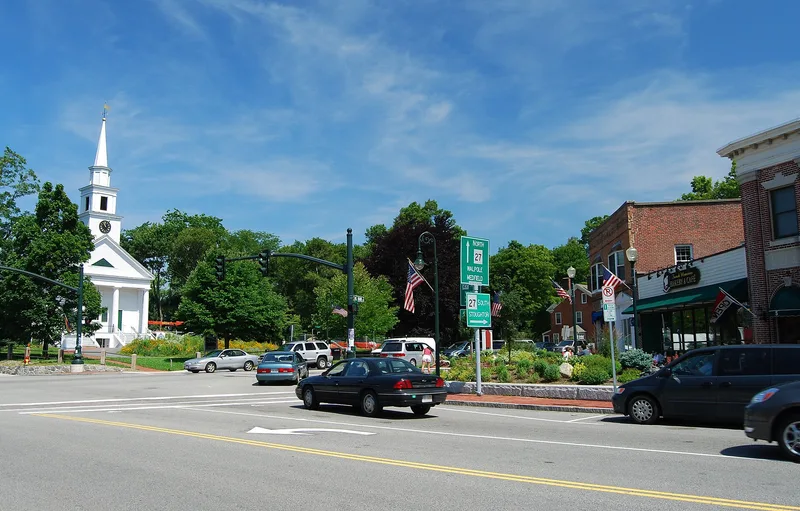
Nine buildings along a single block of North Main Street make up this district in the center of Sharon, Massachusetts. Two white Greek Revival churches, the Unitarian Church of 1842 and the First Congregational Church of 1839, are the visual focal points. Nearby are the Dennett House of 1753, built as a parsonage and the oldest surviving building in the area, and the Morse House of about 1805, reputedly built of brick brought from England as ship ballast. Colonial Revival houses from 1898 and 1905, two further houses from 1910 and 1911, and a 1914 Georgian Revival library complete the group. The library was funded by Andrew Carnegie and designed by C. Howard Walker. The district sits where the Second Precinct of Stoughton first developed in the 1740s, and it is described as the only cohesive group in town that represents Sharon's historic development, set apart from modern commercial and residential surroundings.
Machine-generated summary. This summary was generated by a language model from the official nomination document and has not been reviewed line by line by an editor. It may contain errors. Check the source document before relying on any detail. Source: nomination document (PDF) · catalog entry. Generated October 2026 (model claude-sonnet-5-5, prompt v1.0-2026-10-29).
| Styles | Greek Revival, Georgian Revival, Colonial Revival and Colonial |
|---|---|
| Areas of significance | Exploration/Settlement, Architecture |
| Acreage | 7 |
| Boundary source | not published |
| Full listing page | Sharon Historic District (property record) |
What listing means for this property
This is a historic district. Buildings within its boundary are either contributing (they add to the district's significance) or non-contributing. Owners of contributing income-producing buildings can claim the 20% federal rehabilitation tax credit; homeowners should look at state credits. National Register districts impose no design review by themselves; a local historic district ordinance, if one exists, does (the difference explained).
General information, not legal or tax advice. Rules change; confirm with your State Historic Preservation Office or a qualified adviser.