Russell Center Historic District

Why it's listed
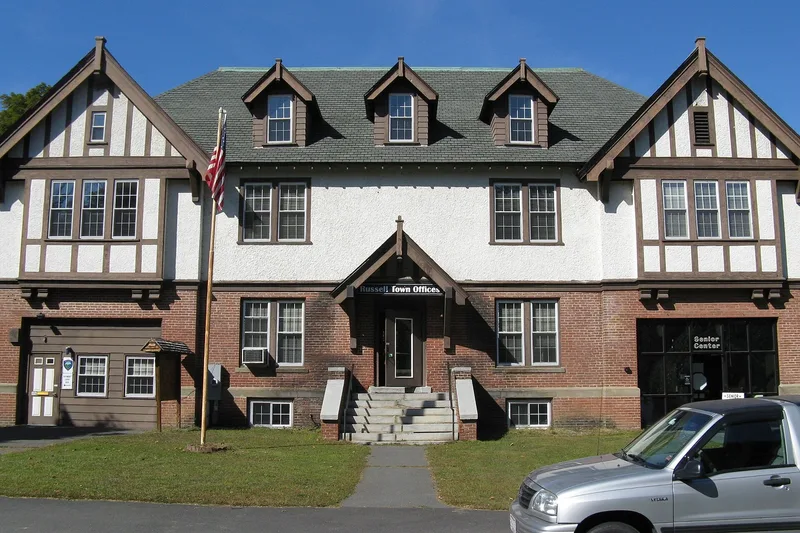
Russell Center is a compact village on a flat floodplain between Route 20 and the Westfield River in the Hampden County hilltown of Russell, Massachusetts. Main Street runs east to west through the district, lined with shade trees and mostly wood-frame houses, churches and civic buildings dating between 1850 and 1895. No building predates 1830. Greek Revival houses such as the Horace Parks House share a local detail of stepped, raking friezeboards in the gable, while modest Gothic Revival cottages, an Italianate villa and Queen Anne houses add variety. The Russell Community Church, built in 1853, has a steeple that serves as a visual landmark. The village took shape after the Western Railroad arrived in 1838, when the center replaced the earlier settlement near Hazard Pond as the town's hub. Residents sold cordwood and lumber, worked for the railroad, and built stores, a hotel and many homes, giving the district the appearance it largely keeps today.
Machine-generated summary. This summary was generated by a language model from the official nomination document and has not been reviewed line by line by an editor. It may contain errors. Check the source document before relying on any detail. Source: nomination document (PDF) · catalog entry. Generated October 2026 (model claude-sonnet-5-5, prompt v1.0-2026-10-29).
| Styles | Greek Revival, Gothic Revival, Italian Villa, Late Victorian/Queen Anne, Colonial Revival, Tudor Revival, Bungalow |
|---|---|
| Areas of significance | Architecture, Transportation, Industry |
| Acreage | 51 |
| Boundary source | NPS cultural-resource GIS polygon |
| Full listing page | Russell Center Historic District (property record) |
What listing means for this property
This is a historic district. Buildings within its boundary are either contributing (they add to the district's significance) or non-contributing. Owners of contributing income-producing buildings can claim the 20% federal rehabilitation tax credit; homeowners should look at state credits. National Register districts impose no design review by themselves; a local historic district ordinance, if one exists, does (the difference explained).
General information, not legal or tax advice. Rules change; confirm with your State Historic Preservation Office or a qualified adviser.