Rogerson's Village Historic District

Why it's listed
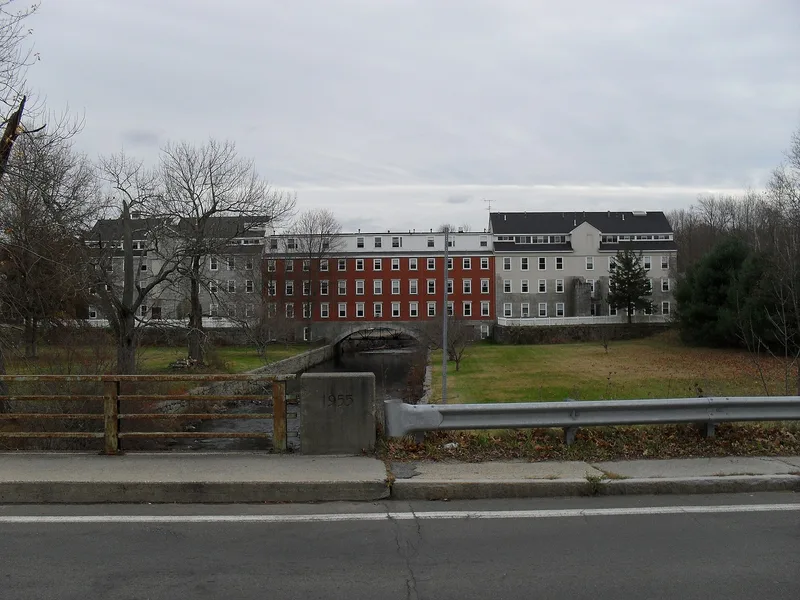
Rogerson's Village is a cotton mill community in North Uxbridge, Massachusetts, arranged along Hartford Avenue and the Mumford River. Its focal point is the pair of stone mills, the Crown (1823-25) and the Eagle (1827), joined by a brick unit of 1851 that spans the river. Nearby are a brick community center with a store, meeting space and tenements, rows of brick workers' cottages, wooden tenements, an owner's house called Gray Rock, and a brick machine shop and storage building. The district was listed because it preserves a nearly complete early 19th-century manufacturing village with few removals or additions since production ended. The Crown Mill is described as the oldest surviving stone mill with a clerestory-monitor roof in Massachusetts, and the village is called the only complex of its quality left in the state's Blackstone Valley. Buildings are grouped by function and placed to suit the terrain, with the mills set apart across a meadow. Fire severely damaged the mills in 1975.
Machine-generated summary. This summary was generated by a language model from the official nomination document and has not been reviewed line by line by an editor. It may contain errors. Check the source document before relying on any detail. Source: nomination document (PDF) · catalog entry. Generated October 2026 (model claude-sonnet-5-5, prompt v1.0-2026-10-29).
| Period of significance | 19th Century; 1823 and following |
|---|---|
| Areas of significance | Industry, Engineering, Architecture |
| Acreage | 27.5 |
| Boundary source | NPS cultural-resource GIS polygon |
| Full listing page | Rogerson's Village Historic District (property record) |
What listing means for this property
This is a historic district. Buildings within its boundary are either contributing (they add to the district's significance) or non-contributing. Owners of contributing income-producing buildings can claim the 20% federal rehabilitation tax credit; homeowners should look at state credits. National Register districts impose no design review by themselves; a local historic district ordinance, if one exists, does (the difference explained).
General information, not legal or tax advice. Rules change; confirm with your State Historic Preservation Office or a qualified adviser.