Princeton Center Historic District

Why it's listed
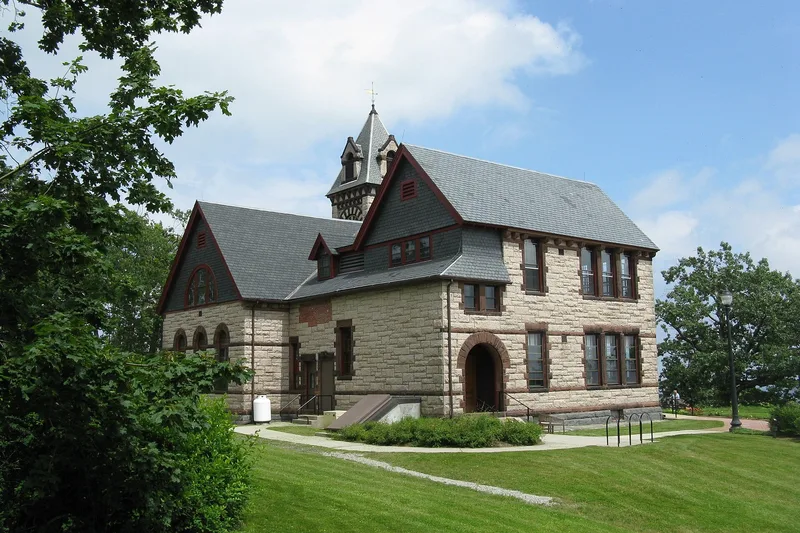
Princeton's town center is organized around a grassy, tree-lined common set on a rising, rocky knoll. At its northern end, two masonry buildings by architect Stephen C. Earle look down over the green. Goodnow Memorial Building, completed in 1883, is a Richardsonian Romanesque structure of Milford granite with brownstone trim and a seventy-foot clock tower. It was built to house both a library and a school. Bagg Hall, the town hall, followed in 1885 in pressed red brick with brownstone trim and a four-story conical-roofed turret. Its upper floor holds a meeting hall with a stage. Both buildings keep much of their original interior woodwork, stairs and stained glass. The district also includes the common itself, a c. 1950 granite War Memorial Bench and a 1992 bandstand that does not contribute to the historic character. Historic houses, a store and a church ring the common outside the boundary, reinforcing the strongly nineteenth-century character of the center.
Machine-generated summary. This summary was generated by a language model from the official nomination document and has not been reviewed line by line by an editor. It may contain errors. Check the source document before relying on any detail. Source: nomination document (PDF) · catalog entry. Generated October 2026 (model claude-sonnet-5-5, prompt v1.0-2026-10-29).
| Styles | Late Victorian: Romanesque (Richardsonian Romanesque and Victorian Gothic/Romanesque Revival) |
|---|---|
| Areas of significance | Architecture, Community Planning and Development, Education |
| Acreage | 11 |
| Boundary source | NPS cultural-resource GIS polygon |
| Full listing page | Princeton Center Historic District (property record) |
What listing means for this property
This is a historic district. Buildings within its boundary are either contributing (they add to the district's significance) or non-contributing. Owners of contributing income-producing buildings can claim the 20% federal rehabilitation tax credit; homeowners should look at state credits. National Register districts impose no design review by themselves; a local historic district ordinance, if one exists, does (the difference explained).
General information, not legal or tax advice. Rules change; confirm with your State Historic Preservation Office or a qualified adviser.