Pelham Town Hall Historic District

The National Park Service has not published a boundary polygon for this district; the map shows the listed properties inside it and the district's reference point.
Why it's listed
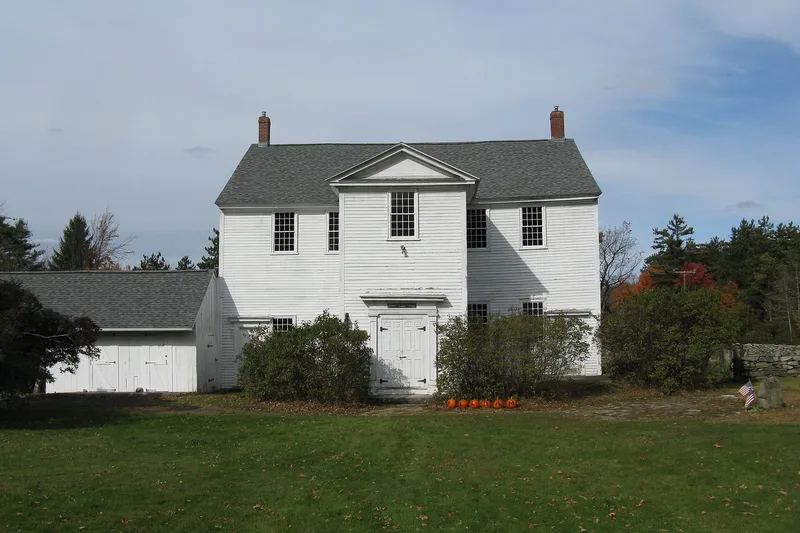
At the corner of Amherst Road and Daniel Shays Highway in Pelham, three town-owned properties form a small civic and religious group: a 1743 Town Hall, a burial ground laid out in 1739, and a white clapboard church built in 1839. The two-story frame Town Hall has a five-bay front with a projecting square entrance porch, a plain pediment and simple classical door surrounds. The church is a one-story Greek Revival building with a broad entablature, corner pilasters and a square belfry topped by an octagonal spire. Town meetings have been held in the hall since 1743, making it the oldest town hall in continuous use in Massachusetts. A separate church only became necessary after an 1833 constitutional amendment separated church and town. The site was also the last major encampment of Daniel Shays' rebels before winter and General Lincoln's pursuit scattered them, and a monument to Shays stands within the district.
Machine-generated summary. This summary was generated by a language model from the official nomination document and has not been reviewed line by line by an editor. It may contain errors. Check the source document before relying on any detail. Source: nomination document (PDF) · catalog entry. Generated October 2026 (model claude-sonnet-5-5, prompt v1.0-2026-10-29).
| Period of significance | 18th and 19th centuries (specific dates 1743, 1739, 1839) |
|---|---|
| Styles | Greek Revival (church); simplified classical details on the Town Hall |
| Areas of significance | Military, Exploration/Settlement, Politics/Government, Architecture, Religion |
| Acreage | 2.6 |
| Boundary source | not published |
| Full listing page | Pelham Town Hall Historic District (property record) |
What listing means for this property
This is a historic district. Buildings within its boundary are either contributing (they add to the district's significance) or non-contributing. Owners of contributing income-producing buildings can claim the 20% federal rehabilitation tax credit; homeowners should look at state credits. National Register districts impose no design review by themselves; a local historic district ordinance, if one exists, does (the difference explained).
General information, not legal or tax advice. Rules change; confirm with your State Historic Preservation Office or a qualified adviser.