Park Street District

The National Park Service has not published a boundary polygon for this district; the map shows the listed properties inside it and the district's reference point.
Why it's listed
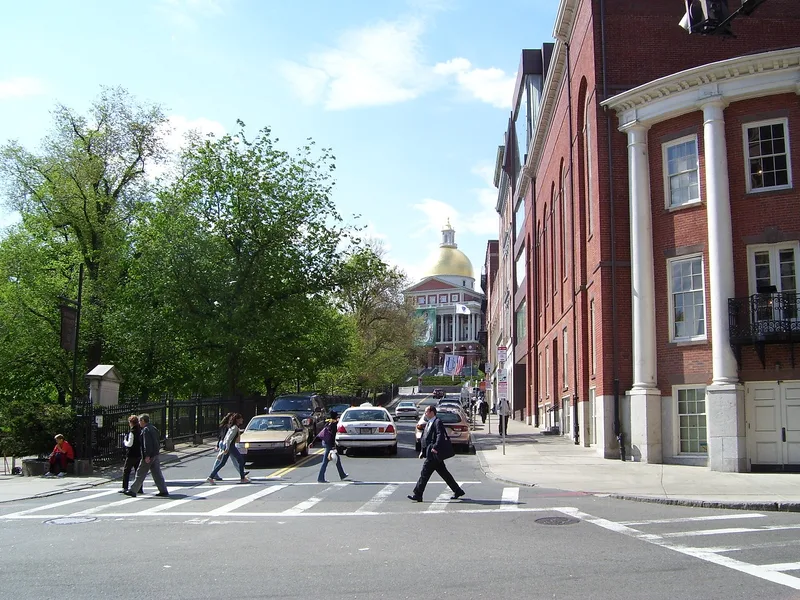
Park Street District is a block of Boston centered on the Granary Burying Ground, with Park Street, Beacon Street and Tremont Street forming its edges. It includes the Park Street Church, designed by Peter Banner in 1809, and the Amory-Ticknor House, built in 1804 from plans by Charles Bulfinch. Later buildings include the Claflin Building of 1883, the Union Club buildings joined in 1896, and the Congregational House of 1898. The Chester Harding House and the Boston Athenaeum are also within the boundaries. The district was nominated because it reflects Bulfinch's plan to improve the edge of Boston Common and the approach to the State House. Although most of his original houses were replaced, the newer buildings follow the set back, height, scale and materials of the early ones. The burying ground, established in 1660, holds the graves of Paul Revere, John Hancock, Robert Treat Paine and victims of the Boston Massacre, and its gravestones illustrate early New England carving.
Machine-generated summary. This summary was generated by a language model from the official nomination document and has not been reviewed line by line by an editor. It may contain errors. Check the source document before relying on any detail. Source: nomination document (PDF) · catalog entry. Generated October 2026 (model claude-sonnet-5-5, prompt v1.0-2026-10-29).
| Styles | Federal, with Greek Revival, Queen Anne and later commercial buildings |
|---|---|
| Areas of significance | Community Planning and Development, Landscape Architecture, Architecture, Religion, Social History |
| Acreage | 1.9 |
| Boundary source | not published |
| Full listing page | Park Street District (property record) |
What listing means for this property
This is a historic district. Buildings within its boundary are either contributing (they add to the district's significance) or non-contributing. Owners of contributing income-producing buildings can claim the 20% federal rehabilitation tax credit; homeowners should look at state credits. National Register districts impose no design review by themselves; a local historic district ordinance, if one exists, does (the difference explained).
General information, not legal or tax advice. Rules change; confirm with your State Historic Preservation Office or a qualified adviser.