Park Square Historic District

Why it's listed
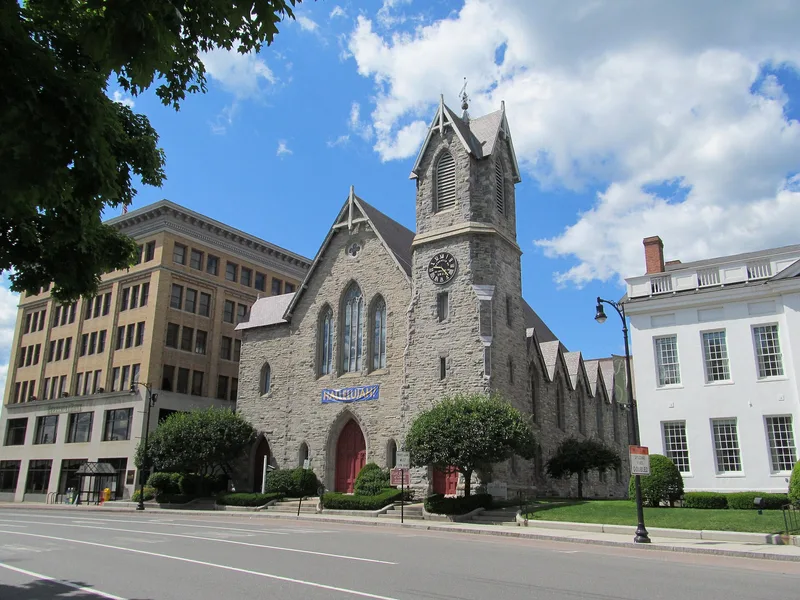
Park Square is the civic heart of Pittsfield, Massachusetts, a small oval park ringed by eight buildings where four main streets converge. The park began as Meeting House Common, land donated in 1790 near the town's first meeting house of 1762. In August 1810 it hosted the country's first agricultural fair, which grew into the Berkshire Agricultural Society, a model for similar groups elsewhere. Soldiers also mustered here for several wars, and a Civil War monument was added in 1872. The surrounding buildings include the Gothic Revival Congregational Church by Leopold Eidlitz, St. Stephen's Church by Peabody and Stearns, the 1872 Court House, the Venetian Gothic Berkshire Athenaeum of 1876, the 1832 Old Town Hall and the Berkshire County Savings Bank. Their designers came from Boston and New York, which gives the district unusual architectural quality for western Massachusetts. Band concerts and a holiday tree still draw people to the square.
Machine-generated summary. This summary was generated by a language model from the official nomination document and has not been reviewed line by line by an editor. It may contain errors. Check the source document before relying on any detail. Source: nomination document (PDF) · catalog entry. Generated October 2026 (model claude-sonnet-5-5, prompt v1.0-2026-10-29).
| Period of significance | 1700-1799, 1800-1899, 1900- |
|---|---|
| Styles | Mixed: Gothic Revival, English Gothic Revival, Lombardi Romanesque, Venetian Gothic, late Federal |
| Areas of significance | Agriculture, Military, Politics/Government, Architecture |
| Acreage | 9 |
| Boundary source | NPS cultural-resource GIS polygon |
| Full listing page | Park Square Historic District (property record) |
What listing means for this property
This is a historic district. Buildings within its boundary are either contributing (they add to the district's significance) or non-contributing. Owners of contributing income-producing buildings can claim the 20% federal rehabilitation tax credit; homeowners should look at state credits. National Register districts impose no design review by themselves; a local historic district ordinance, if one exists, does (the difference explained).
General information, not legal or tax advice. Rules change; confirm with your State Historic Preservation Office or a qualified adviser.