Oxford-Crown Extension District

Why it's listed
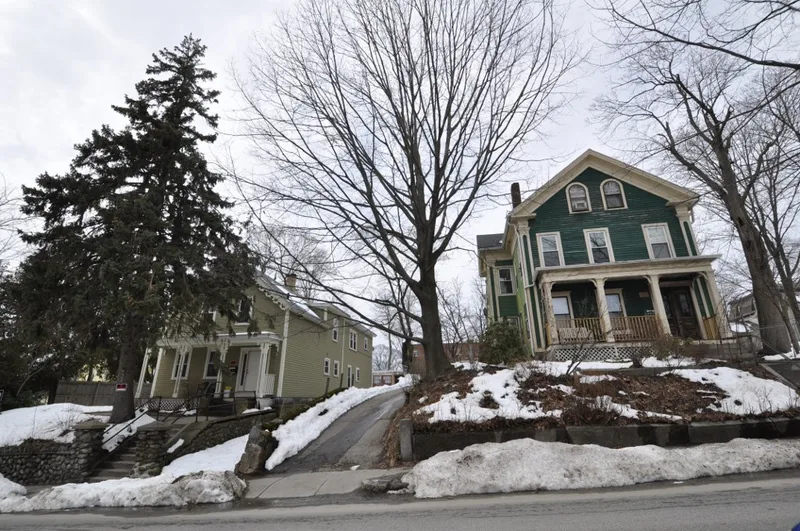
This residential district in Worcester, Massachusetts, extends the neighboring Oxford-Crown Historic District across Austin, Chatham, Congress, Crown and Pleasant Streets. Most of its buildings date from about 1851 to 1870, when the streets were opened and quickly filled with side-hall houses with gabled or pedimented facades. Early residents were artisans, small-scale manufacturers and businessmen. Many houses are Greek Revival, while others mix that style with Italianate brackets and porches. Rarer examples include 98 Austin Street, one of the city's few temple-front Greek Revival houses, and 16 Congress Street, a three-and-a-half-story architectural curiosity. Along Pleasant Street, brick apartment and row house blocks from 1870 to 1888 reflect late nineteenth-century redevelopment of main roads. Granite walls, gate posts and stairways add to the area's character. Together with the adjoining district, it preserves a large share of one of Worcester's earliest residential neighborhoods.
Machine-generated summary. This summary was generated by a language model from the official nomination document and has not been reviewed line by line by an editor. It may contain errors. Check the source document before relying on any detail. Source: nomination document (PDF) · catalog entry. Generated October 2026 (model claude-sonnet-5-5, prompt v1.0-2026-10-29).
| Period of significance | ca. 1849-1888 |
|---|---|
| Styles | Mixed Victorian: Greek Revival, Italianate, Second Empire, Queen Anne and Victorian Gothic elements |
| Areas of significance | Community Planning and Development, Architecture |
| Acreage | 5.5 |
| Boundary source | NPS cultural-resource GIS polygon |
| Full listing page | Oxford-Crown Extension District (property record) |
What listing means for this property
This is a historic district. Buildings within its boundary are either contributing (they add to the district's significance) or non-contributing. Owners of contributing income-producing buildings can claim the 20% federal rehabilitation tax credit; homeowners should look at state credits. National Register districts impose no design review by themselves; a local historic district ordinance, if one exists, does (the difference explained).
General information, not legal or tax advice. Rules change; confirm with your State Historic Preservation Office or a qualified adviser.