Northampton State Hospital

Why it's listed
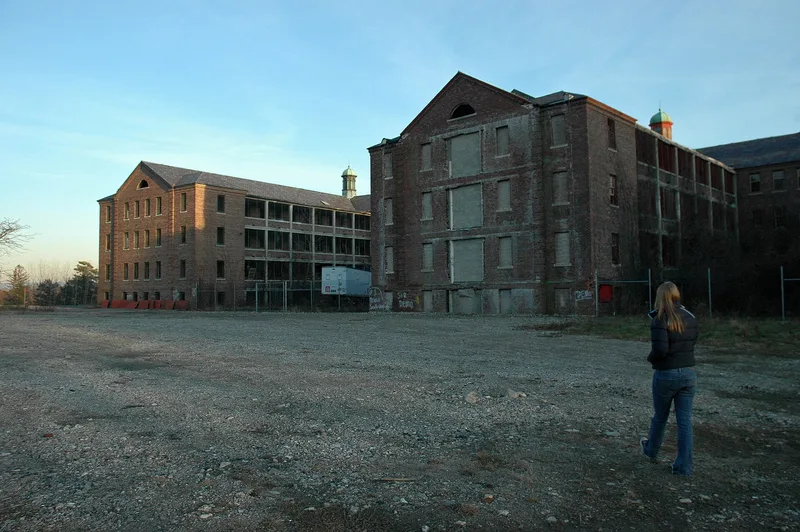
Northampton State Hospital is a 530-acre campus on a hilltop overlooking downtown Northampton, begun in 1855 as the Lunatic Hospital at Northampton. Its centerpiece is a three-story red-brick building designed by Boston architect Jonathan Preston in the Gothic Revival, or "Elizabethan," style. It follows the Kirkbride plan, with a central administrative core and stepped-back wings planned for 250 patients. Lawns, tree groves and winding drives were laid out as pleasure grounds, and farmland extends to the west. Pliny Earle, superintendent from 1864 to 1886, wrote widely on the prevention and curability of insanity, partly from his observations here. In the late 1920s and 1930s, the Memorial Group south of Prince Street was added to relieve overcrowding. Gordon Robb designed it in Colonial Revival style, and federal relief programs paid for most of it. The campus retains high integrity, though the Main Building has long stood vacant and deteriorating.
Machine-generated summary. This summary was generated by a language model from the official nomination document and has not been reviewed line by line by an editor. It may contain errors. Check the source document before relying on any detail. Source: nomination document (PDF) · catalog entry. Generated October 2026 (model claude-sonnet-5-5, prompt v1.0-2026-10-29).
| Period of significance | 1855-1940 |
|---|---|
| Styles | Mid 19th Century: Italianate, Gothic Revival; Late Victorian: Renaissance Revival, Queen Anne; Late 19th and 20th Centuries: Colonial Revival, Classical Revival; Other: Utilitarian |
| Areas of significance | Architecture, Social History, Health/Medicine |
| Acreage | 530 |
| Boundary source | NPS cultural-resource GIS polygon |
| Full listing page | Northampton State Hospital (property record) |
What listing means for this property
This is a historic district. Buildings within its boundary are either contributing (they add to the district's significance) or non-contributing. Owners of contributing income-producing buildings can claim the 20% federal rehabilitation tax credit; homeowners should look at state credits. National Register districts impose no design review by themselves; a local historic district ordinance, if one exists, does (the difference explained).
Noted as vacant in the nomination. Nomination documents can be decades old; current status may differ. If you are considering buying an empty listed property, read the due-diligence checklist.
General information, not legal or tax advice. Rules change; confirm with your State Historic Preservation Office or a qualified adviser.