North Bellingham Cemetery and Oak Hill Cemetery

The National Park Service has not published a boundary polygon for this district; the map shows the listed properties inside it and the district's reference point.
Why it's listed
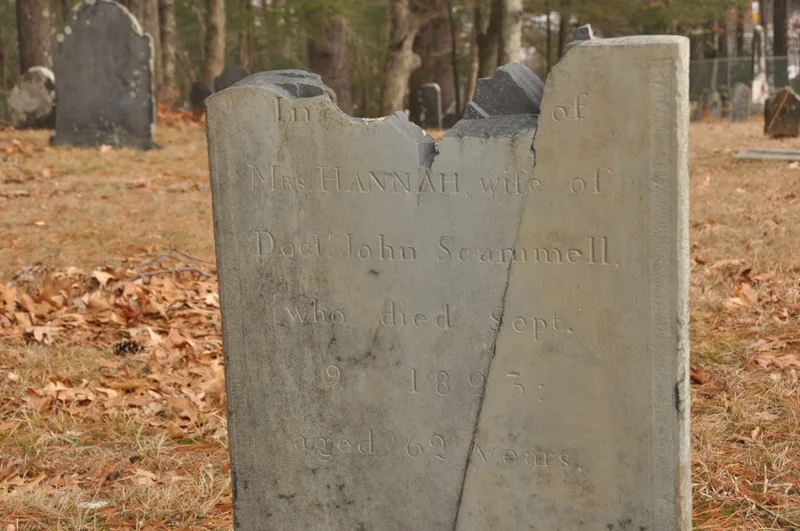
Two neighboring cemeteries on Hartford Avenue in North Bellingham, Massachusetts, form this district. North Bellingham Cemetery, the town's oldest burying ground, was in use by 1718 and holds burials from 1712 to 1888. Its roughly 130 headstones, mostly slate and marble, show changing carving styles, and two stones are attributed to Joseph Barbur, Jr. Two receiving tombs, dated to 1804 but later rebuilt in granite, were used for winter storage of the dead. Oak Hill Cemetery was founded in 1849 by residents of the northern part of town as a designed alternative, with about 800 markers arranged in rectilinear family lots, many with curbing. It remains active. Its marble and later granite monuments reflect Victorian sentiment, and a few white bronze markers appear. A shared fieldstone perimeter wall, varying in height and construction, runs along the road frontage. Together the cemeteries record the town's founding families and the shift from informal burial grounds to planned family plots.
Machine-generated summary. This summary was generated by a language model from the official nomination document and has not been reviewed line by line by an editor. It may contain errors. Check the source document before relying on any detail. Source: nomination document (PDF) · catalog entry. Generated October 2026 (model claude-sonnet-5-5, prompt v1.0-2026-10-29).
| Areas of significance | Art, Community Planning and Development, Social History |
|---|---|
| Acreage | 3.6 |
| Boundary source | not published |
| Full listing page | North Bellingham Cemetery and Oak Hill Cemetery (property record) |
What listing means for this property
This is a historic district. Buildings within its boundary are either contributing (they add to the district's significance) or non-contributing. Owners of contributing income-producing buildings can claim the 20% federal rehabilitation tax credit; homeowners should look at state credits. National Register districts impose no design review by themselves; a local historic district ordinance, if one exists, does (the difference explained).
General information, not legal or tax advice. Rules change; confirm with your State Historic Preservation Office or a qualified adviser.